A sample text widget
Etiam pulvinar consectetur dolor sed malesuada. Ut convallis
euismod dolor nec pretium. Nunc ut tristique massa.
Nam sodales mi vitae dolor ullamcorper et vulputate enim accumsan.
Morbi orci magna, tincidunt vitae molestie nec, molestie at mi. Nulla nulla lorem,
suscipit in posuere in, interdum non magna.
|
Posted By Teresa Redder, on October 1st, 2026 JOYFUL GOSPEL LIVING – 27th SUNDAY IN ORDINARY TIME (OCTOBER 4, 2026)
“I have chosen you from the world, says the Lord.”
This weekend, the Scriptures provide us with the images of vineyards that God planted with the hope of producing good fruit. The Prophet Isaiah compared the disappointing vineyard yield in his prophecy to the fickle people of Israel, with only wild grapes after careful cultivation.
Psalm 80 and its response “The vineyard of the Lord is the house of Israel” also provided a meditation on the relationship of God with His vineyard–His chosen people. Finally, the Gospel provided a parable from Jesus with the warning to take our calling seriously to do what God expects of us.
When we hear the Gospel acclamation at Mass, the cantor sings a verse from Scripture in between our Alleluias. Along with the images of vineyards, the Gospel acclamation tells us: “I have chosen you from the world, says the Lord.” How aware are we of what it means to be chosen?
This year, the feast of St. Francis falls on the 27th Sunday of Ordinary Time with these powerful readings to contemplate. We know that when Christ spoke to Francis from the Crucifix of San Damiano, the saint took literally what he heard: rebuild run-down churches (later, he understood that Christ meant His Church); renounce worldly allures, including his father’s ambitions for him; give up all of his possessions; and go from town to town proclaiming the Good News by living it with joy and fidelity.
Because this has been a Jubilee Year of St. Francis that has marked the 8th Centenary (800 years) since his passing to eternal life, the friars of the OFM Conventual shared a novena that began on September 25th to reflect on the life of Saint Francis from the perspective of nine colleagues (eight brothers in the Order and Lady Jacopa de Settesoli (a noblewoman whom Francis called “Brother”), who are buried close to St. Francis in the Basilica in Assisi.
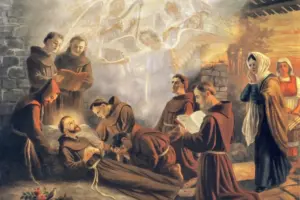
Just as Christ chose Francis and has chosen us, Francis likewise invited others to follow Christ. One of his original brothers was the nobleman Rufino of Assisi, who is buried in the crypt church with Francis. On the eighth day of the novena, Rufino reflected on his personal experience of what it meant to embrace Christ as Francis did. The setting for this reflection is in the courtyard of the bishop of Assisi:
“My family were nobility. When the townspeople rose and burned the great houses we ran to Perugia, and [Saint] Clare, who is my cousin, was a small child in that flight. So when I tell you that a town can tear itself in half, I am not speaking generally. I prayed. That is what I did and it is very nearly all I did. I was no use in conversation, I could not preach, and when Francis made me go and preach anyway I did it half undressed and made a fool of myself, and then he came and did the same beside me so that I would not be the only fool in the town square.
Then the bishop excommunicated the mayor, and the mayor forbade the town to do business with the bishop, and not one churchman and not one layman went near either of them. Francis was in bed and going blind, and what he said was this. It is a disgrace to you, servants of God, that these two hate each other and nobody is doing anything about it. To us. He said it to us, the praying ones.
Then he wrote one verse, and he sent us to sing it. I have no voice. I never had one. But he did not ask me to make a speech, and he did not ask me to be persuasive, and he did not ask me to be right. He asked me to carry his words across a courtyard and let them out of my mouth. So we stood in front of the bishop and the mayor and half the city and we sang, and the mayor knelt down on the stones, and the bishop said he was quick-tempered and sorry for it, and it was over. I could not preach. I could sing another man’s poem. It turned out that was enough. Prayer that will not get up and walk across a courtyard is not yet prayer.”
What would we do if we were chosen to bring a message to two powerful and quarreling people? Would we feel inadequate? How would our message be received? Would they hear the voice of Christ in the message?
The verse that Francis gave to Rufino was an addition to his Canticle of the Creatures:
“Praised be to You, my Lord, though those who give pardon for Your love, and who bear infirmity and tribulation. Blessed are those who endure in peace, for by You, Most High, they shall be crowned.”
What faith it took to be obedient and bring the message of that song to the bishop and the mayor! Rufino learned to practice prayer without ceasing. God’s vineyard in Assisi, which had previously been witness to a most public quarrel, likewise saw reconciliation through the words of a song. These stories give us such hope for our world, if we only choose to remember that we too are chosen by God to share His love in our world.
For many generations, God has looked after His vineyard with loving care. God provides for all of our needs, as we hear in the song “Table Of Plenty.” With each new day, we have the opportunity to be aware of God’s Presence in our lives and to desire a relationship with Him above all other desires. God will never disappoint that kind of longing because His love for us is boundless.
If we become acutely aware that we are chosen, then we will open ourselves to the graces to be found in God’s vineyard and we will act with great purpose:
“…go and bear fruit that will remain.”
Teresa S. Redder, OFS
Saint Katharine Drexel Regional Minister
Posted By Teresa Redder, on September 27th, 2026 At the request of the two fraternities in the Diocese of Camden (Christ the King and Divine Mercy Fraternities), Bishop Joseph Williams concelebrated the Mass of Care for Creation at the Church of the Incarnation in Mantua, NJ, at 11 :00 AM on Saturday, September 26, 2026.
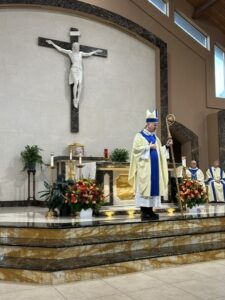
The concelebrants were:
Fr. Stephen Rapposelli (Pastor)
Fr. Shaji Muttathottil (Parochial Vicar)
Fr. Joseph Monahan, TOR (Spiritual Assistant to Divine Mercy Fraternity)
As our Region focuses on building strong relationships within our dioceses, the greater Franciscan Family in our area, and with other local fraternities, this day was truly blessed– to be with Bishop Williams, who shared an inspiring homily with us about the legacy of Saint Francis through his Canticle of Creatures, his stigmata, and his Transitus. After the Mass, it was wonderful to spend time with the Bishop in the Kernan Center, where the tables were laden with delicious goodies to be shared.
Despite the rain and wind from the Nor’easter affecting our area, this event happened with such Franciscan spirit and joy.
Many thanks to all of the people who helped to make this special day with the Bishop a reality: Jen Drees, OFS (and her husband, Deacon Mike Drees), Kathy Agosto, OFS, and James Wileczek, OFS, as well as the many people who participated in the music ministry, served as hospitality ministers at the Mass, brought refreshments and helped with the logistics in Kernan Hall, and donated so generously of time and talents.
This is a very special Jubilee Year 2026 remembrance for our Region. Keep your eye out for the “Catholic Star Herald,” the diocesan newspaper, as there were staff members taking photos and doing interviews.
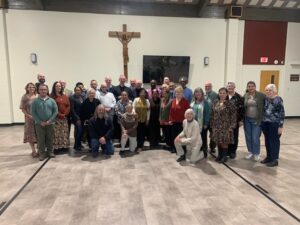
What a great prelude this is to the week in which we will celebrate the Transitus and the feast day of St. Francis!
Peace and all good,
Teresa Redder, OFS
Regional Minister
Posted By Teresa Redder, on September 1st, 2026 St. Katherine Drexel Regional Fraternity
Regional Spiritual Assistant
St. Francis of Assisi Friary
1901 Prior Road
Wilmington, Delaware 19809
tel: (302) 798-1454 fax: (302) 798-3360 website: skdsfo email: pppgusa@gmail.com
September 2026
Dear Sisters and Brothers in St. Francis,
Blessed are those who endure in peace
For by You, Most High, shall they be crowned.
Praised be You, my Lord, through our Sister Bodily Death, from whom no one living can escape.
Woe to those who die in mortal sin.
Blessed are those whom death will find in Your most holy will,
For the second death shall do them no harm.
Praise and bless my Lord and give Him thanks and serve Him with great humility.
Thus ends the beautiful poem/hymn that St. Francis of Assisi composed shortly before he died. His journey to eternity through the experiences of his life was adventuresome. The personality of Francis did not allow half measures. It was all or nothing. He partied well and spent his father’s money lavishly. He prayed intensely, ultimately being so conformed to the Object of his Love and prayers as to bear visibly the signs of a Love beyond all love, beyond all imagining.
Yet, here we are, at the end of his beautiful hymn praising God and His creation, and we see words like “death”, “mortal sin”, “second death”. The depth of meaning and true spiritual beauty in this last part of the Canticle is not recognized at first. When taken in the context of the whole Canticle praising God for His goodness and attributes in various areas of creation, the “godliness” St. Francis indirectly implied helps one to enter the heart of Francis. His was sadness for those who as yet have not realized the joy, peace, love that they have deprived themselves.
The closing words of St. Francis of Assisi’s Canticle of the Creatures present a profound theology of human existence: the human person is called to endure suffering peacefully, to confront mortality without despair, to live according to the will of God, and ultimately to praise the Creator in humility. The lines, Blessed are those who endure in peace, By You Most High, they will be crowned, followed by the praise of Sister Bodily Death, should not be understood simply as a meditation on dying. Rather, they articulate a distinctly Christian vision in which suffering, death, moral responsibility, and praise are gathered into one spiritual drama. Francis transforms experiences that ordinarily provoke fear – conflict, suffering, and death – into opportunities for communion with God.
The first significant idea is the blessing of those who endure in peace. Peace in Franciscan spirituality is not merely the absence of external conflict. It is an interior disposition grounded in trust in God. To endure does not mean passively accepting injustice or refusing to acknowledge suffering. Endurance signifies the spiritual capacity to remain oriented toward the good even when circumstances are painful, uncertain, or apparently unjust. Francis understands peace as something received, a “gift”, by You Most High. Authentic peace is ultimately theological rather than psychological. It does not depend entirely upon human control over circumstances. It arises from confidence that just being alive – existence – possesses a meaning beyond immediate suffering.
The promise that such persons will be crowned urges us to reflect upon the fulfillment of creation when there will be a new heaven and a new earth. Human suffering is placed within the horizon of eternity. The crown symbolizes fulfillment, victory, and participation in divine life. The Christian understanding of endurance differs fundamentally from accepting what you cannot change. Stoicism, as it is called, can emphasize self-mastery and independence from external circumstances, but Franciscan spirituality emphasizes dependence upon God. The person does not conquer suffering through sheer strength but discovers, through grace, how suffering can become a place of fidelity. The crown is consequently not a prize earned through human perfection but the completion of God’s “gift” of a life ordered toward God.
This theological movement prepares for the remarkable phrase, Praised be You, my Lord through Sister Bodily Death. Francis does something intellectually and spiritually radical by calling bodily death Sister. Death is normally imagined as an enemy, an interruption, or the negation of life. Francis does not deny its terror; rather, he places death as another piece of the puzzle of creation. It is part of the vocabulary of creation. If the sun, moon, water, fire, earth, and animals can be understood as brothers and sisters because they belong to the one Creator, then even death can be addressed within the framework of relationship.
Calling death Sister does not mean that death is necessarily good. Christianity maintains a distinction between creation as willed by God and death as an expression of humanity’s fallen condition. Yet Francis refuses to allow death to have the final word. Why, because the Creator is greater than death. Death itself can be incorporated into the mystery of divine providence. The phrase therefore expresses neither romanticism about dying nor indifference toward life. Instead, it represents a profound act of theological reorientation: Francis places death inside the larger reality of God.
The statement that death is from whom no-one living can escape introduces a great truth. Mortality is one of the fundamental conditions of human existence. Regardless of wealth, social status, intellectual achievement, or physical strength, every human being eventually encounters bodily death. Francis therefore confronts the illusion of human total control in all aspects and times of life. The question is about autonomy. Death exposes the limits of possession and control. What a person owns cannot ultimately be taken beyond mortality. What matters is the manner in which one has lived before God.
This insight gives particular significance to the warning, Woe to those who die in mortal sin! Francis immediately distinguishes between two ways of encountering death. The issue is not simply whether one dies, because everyone dies. The deeper question concerns the moral and spiritual condition in which one encounters death. Death reveals the orientation of the human person. A life fundamentally turned away from God cannot be reconciled with the vision of divine communion expressed throughout the Canticle. How sad for one to live in a state that deprives them of the serenity and joy of a deep relationship with Life Himself. Here we understand more the words: Woe to those who die in mortal sin. How sad! How unfortunate! These persons have deprived themselves, until they receive the grace of full forgiveness, of the joy of literally feeling the closeness of the soul with God. Such an intimacy can never be explained or even described completely. It can only be lived. It envelops the person with an inexplicable Presence. Francis’ “woe” is a sadly felt lament for those who failed to recognize the joy just within their reach. He prays they will hear and understand the joy just within reach. This joy would be a sign of the joy that is within the reach of every person.
The phrase Blessed are they whom Death will find in Your Will provides the positive counterpart. The blessed person is not described primarily as intellectually accomplished, materially successful, or socially powerful. The criterion is fidelity to divine will. This is central to Franciscan spirituality. The human person finds freedom not through absolute self-determination but through loving union with God. To do God’s will is to discover one’s proper relationship to the Creator, creation, other people, and oneself.
So it follows that No second death can do them harm, and the phrase deepens this distinction. Physical death is universal, but spiritual death is not inevitable. The language recalls the Christian conviction that separation from God is more serious than biological mortality. A person who dies physically while remaining oriented toward God does not experience death as ultimate destruction. The resurrection of Christ transforms the meaning of death: what appears to be an ending can become passage into fuller life.
St. Francis concludes not with fear but with praise: Praise and bless my Lord and give Him thanks, and serve Him with great humility. These last words summarize the entire spiritual logic of the Canticle. Praise, thanksgiving, service, and humility are inseparable. The proper response to life in this world is not domination but gratitude. The world is not merely an object available for human use, or worse, exploitation; it is a gift received from the Creator. Likewise, human life is not self-generated possession but a gift whose ultimate meaning lies in relationship with God.
We see then why humility is especially important. Francis does not conclude by claiming that human beings have mastered the mystery of life. Instead, they are called to serve. Humility recognizes both human dignity and human limitation. The human person is valuable because he or she is loved and created by God, yet is not God. Such humility liberates the individual from the illusion that everything must be controlled, possessed, or understood.
Taken together, these verses form a logical and consistent spiritual understanding that the human being is a mortal creature who nevertheless possesses an eternal vocation. Suffering tests fidelity; peace expresses trust; death reveals human dependence; moral action expresses orientation toward God; and humility becomes the appropriate response to the mystery of creation. Francis does not escape the realities of suffering and death by denying them. He transforms their meaning through faith.
The deepest message of the last words of the Canticle is therefore that Christian hope does not consist in avoiding mortality but in learning how to live faithfully within mortality. To endure in peace, to accept Sister Bodily Death, to reject mortal sin, to do God’s Will, and to serve with humility are dimensions of a single spiritual vocation. Francis ultimately teaches that the meaning of life is not found in conquering death but in living so completely in relationship with God that death itself cannot destroy that relationship. The final word is consequently praise: not because suffering and death are insignificant, but because neither possesses the power to overcome the love and life of the Creator.
Surrendering life to the Creator opens the heart view to a panorama of light, beauty, love, grace that otherwise would be in the cloudy oblivion of uncertainty and fear. Every prayer of trust is a little surrender. Every time we place another person’s needs before our own, we are learning the freedom of love. In this sense, Francis’s final words in the Canticle are a meditation not on death but really a meditation on discipleship. And that carries a promise that: No second death can do them harm, pointing beyond physical death toward the deeper spiritual reality of eternal life.
This is where the entire Canticle reaches its climax. Francis has been praising creation, but creation itself is not God. Everything points beyond itself. Creation is a sign. The created world teaches us gratitude, humility, dependence, wonder, and praise. But ultimately all created things are passing. The sun rises and sets. Flowers bloom and wither. Seasons change. Our bodies grow old. Relationships change. Life moves toward death. And still God remains.
Therefore, the final lesson of the Canticle is not simply to appreciate creation. It is to pass through creation toward the Creator. Francis’s vision is profoundly incarnational. He does not despise the material world. He loves it because it reveals God’s generosity. Yet he never confuses the gift with the Giver. This is perhaps why the last words are so simple: Praise and bless my Lord and give Him thanks, and serve Him with great humility.
For the beginning and the end of everything is God. And in God, even death cannot have the final word. Amen.
Peace and Blessings
Fr. Francis A. Sariego, O.F.M. Cap.
Regional Spiritual Assistant
Posted By Terri Leone, on August 30th, 2026 So sorry the link I sent the other day regarding “The Easter of Francis” didn’t work. Sorry for the inconvenience if you tried it and received an error message.
The one below works for me today so it should work for you as well.
Peace,
Terri
https://www.secularfranciscansusa.org/centenary-resources-the-easter-of-francis-of-assisi/
Posted By Terri Leone, on August 29th, 2026 Have you visited the Centenary pages for “The Easter of St. Francis” on our National website recently?
https://www.secularfranciscansusa.org/centenary-resour…rancis-of-assisi/
Some new items have been added that you might be able to use. Check it out!
Posted By Terri Leone, on August 12th, 2026 Peace and Joy!
Current/Up to Date “Regional Forms” may be found in right hand column in the alphabetical list under “Regional Documents, Procedures, etc.”
Please do not use forms listed with “Section 2 Regional Handbook” Thanks.
Posted By Teresa Redder, on May 9th, 2026 Joyful Gospel Living
“Come to Him, a living stone…chosen and precious in the sight of God.”
Background:
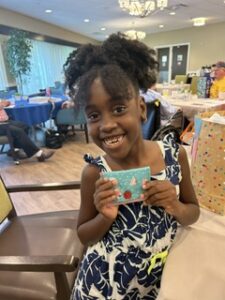
Like many other fraternities, our local fraternity (Holy Assumption-Roebling, NJ) prayed that we might find a common apostolate. At the suggestion of one of our members, we decided that this should be a pro-life apostolate. After exploring several options in our local area, we made arrangements to meet Clare Kirk, OFS (belonged to St. Peter Fraternity in Riverside, NJ) , who worked at Good Counsel Home in Riverside with expectant and new mothers. She gave us a tour of the facility and what the needs were. Later, she visited our fraternity and spoke to our membership about this life-giving ministry. In a follow-up phone call, Clare mentioned to me that there was an even greater need to assist the mothers after their two years of association with the home, when their life skills were put to the test and they sometimes struggled to adjust. At that time, Clare maintained contact with seven alumnae (new mothers) who were trying to make a life for themselves and their new babies. Our fraternity made a commitment to help one of those mothers (Emma) and her 18-month old baby Essence. It has been a wonderful journey of accompaniment for all of us. This June, Essence will be 14 years old and graduating from 8th grade!
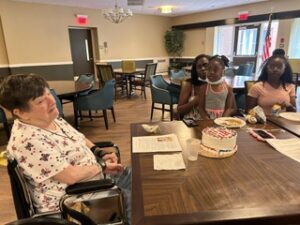
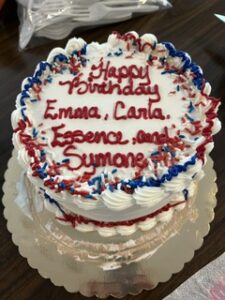
One of our fraternity members has been at the Masonic Village in Burlington, NJ, for many years now. Every year, we take fraternity to Carla to celebrate her birthday (June 29th). Emma and Essence celebrate birthdays in May and June respectively, so Carla gets to enjoy a triple celebration. How special will the visit be this year! Little sister Symone’s birthday is in September, but she gets to party, too. Carla looks forward to these visits and lavishes affection on Emma and the girls.
Reflection:
A few years ago, my husband Jeff and I made a trip to the White Mountains of Maine to visit one of my brothers and his wife. They live on Mt. Abram, but their home provides easy access to the Presidential range in New Hampshire and the Appalachian Trail (AT) as it crosses into Maine. One day, we decided to take a hike on the AT and found a trailhead to Table Rock, famous locally for the spectacular views when reaching the summit. As we hiked the rugged trail, we encountered the characteristic terrain details of Maine: stones, rocks, and boulders! When we were about 2/3 of the way up, we were both envious of bighorn sheep and their abilities to traverse such terrain!
What does a living stone look like? In St. Peter’s epistle, he encourages the local Church to “Come to Him, a living stone, rejected by human beings, chosen and precious in the sight of God.” This was an appeal to people of faith to turn to the Light of Christ and have a desire to be a living stone to build up the Church as a visible sign of Christ’s presence in our world.
On April 14th, the Franciscan Action Network (FAN) hosted a one-hour webinar to encourage people of faith to advocate for a just Farm Bill. This important legislation not only protects the needs of farmers who raise the food that will nourish our country and people in faraway lands, but it also funds the Supplemental Nutrition Assistance Program (SNAP) and The Emergency Food Assistance Program (TEFAP). Both of these programs are critical to the life and dignity of people affected by poverty.
From dialogue with the coordinators at FAN, I knew that their promotion of advocacy was to get constituents to write to the members of Congress to make it a priority to preserve funding for those who are in need. When the One Big Beautiful Bill was passed last fall, there was intention to cut $30B of SNAP funding over the next decade. The proposed budget for FY2027 includes a $4.9B reduction to SNAP. What must a living stone do to build the spiritual house whose cornerstone is Jesus Christ? These reductions have a direct impact on struggling families like Emma’s.
I visited the Catholic Charities USA website to see what the impact has been. In recent news, I found a link to a letter to the Senate Committee on Appropriations by Kerry Alys Robinson, the President and CEO of Catholic Charities USA, in which she wrote on behalf of the 169 diocesan Catholic Charities agencies in the US to make an urgent appeal for the vulnerable in our society:
https://www.catholiccharitiesusa.org/wp-content/uploads/2026/04/letter-appropriations-labor-hhs-fy2027.pdf
In the introduction to her letter, Robinson wrote:
“As you consider the Fiscal Year 2027 Labor, Health and Human Services, and Education (Labor-HHS) appropriations bill, Catholic Charities USA (CCUSA) urges you to invest in programs that protect and support poor and vulnerable children, seniors, families, people facing behavioral and mental health crises, workforce development and training.”
As living stones, we can choose to place ourselves where we intentionally build a strong structure. The Gospel teaches us how we are to live by loving one another and following the example of Jesus in seeing Him in one another. In this weekend’s Gospel from St. John, Jesus tells His followers: “Amen, amen, I say to you, whoever believes in Me will do the works that I do, and will do greater ones than these, because I am going to the Father.”
What is ours to do? In our parish life, we know that there is a ministry to those in need through the efforts of our St. Vincent de Paul Society. Many people come to our food pantry for temporary and sustaining assistance. In many cases, many of those families also receive SNAP benefits, but they do not cover the growing expenses of our world today. As draconian cuts are made to these critical benefits, how will families cope? What must living stones do for one another? How does our faith in God inspire us to do the work as Christ, our foundation, would?
For 13 years, our Secular Franciscan fraternity has accompanied a young single mother and her two daughters as a pro-life ministry. Through this accompaniment, we have learned a great deal about the difficulties that poor people face with the very basics of society: food nourishment; affordable housing; sources of basic material needs such as clothing, furniture, public transportation, legal protection; and serious safety concerns when living and working in dangerous areas. These experiences are part of an ongoing conversion for those who sincerely want to be living stones for Christ.
When Pope Francis released his encyclical Fratelli Tutti in 2020, I explored the Catechism of the Catholic Church (CCC) using the search engine for “common good” and found 73 results. In Part Three (Life in Christ), there was a resonating teaching for living stones:
“Freedom is exercised in relationships between human beings. Every human person, created in the image of God, has the natural right to be recognized as a free and responsible being. All owe to each other this duty of respect, the right to the exercise of freedom, especially in moral and religious matters, is an inalienable requirement of the dignity of the human person. This right must be recognized and protected by civil authority within the limits of the common good and public order.” (CCC, 1738)
The Beatitudes are our blueprint for building the Kingdom of God here and now. Jesus teaches us that God’s reign is visible where people respond to the needs for righteousness and justice with mercy and compassion. There are so many needs in our world today. Sometimes, there can be a global impact by a singular event (e.g., the Chernobyl nuclear disaster). Every person of faith is called to be a living stone, and then it is good to:
“…let yourselves be built into a spiritual house.”
Teresa S. Redder, OFS
Saint Katharine Drexel Regional Minister
Posted By Teresa Redder, on April 26th, 2026 On Sunday, April 26, 2026, Saint John the Evangelist Fraternity held a Chapter of Elections at St. John the Evangelist Parish Center in Philadelphia, PA. The presider was Teresa Redder, OFS (Regional Minister) and the ecclesial witness (delegate) was Fr. John McCloskey, OFM Cap.
It is such a great joy to see the election of two newly professed members (Adriano and Victor) to the Fraternity Council with a great desire to serve the Lord with gladness.
We give thanks to God for all of these newly elected servant leaders of this local fraternity. May God continue to bless them with the fidelity to serve with great humility!
| COUNCIL POSITION |
MEMBER |
NOTES |
| Minister |
Carolyn Murray, OFS |
Reelected |
| Vice Minister |
Terry Guerra, OFS |
Newly elected |
| Secretary |
Adriano Duque, OFS |
Newly elected |
| Treasurer |
Bob McKee, OFS |
Newly elected |
| Formation Director |
Venus Murphy, OFS |
Reelected |
| Councilor-at-Large |
Víctor Sanchez, OFS |
Newly elected |
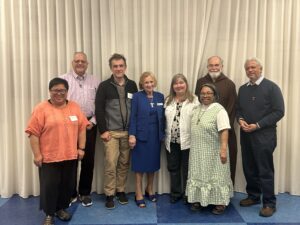
Left to right: Terry Guerra, OFS; Bob McKee, OFS; Adriano Duque, OFS; Carolyn Murray, OFS; Teresa Redder, OFS; Venus Murphy, OFS; Fr. John McCloskey, OFM Cap; and Victor Sanchez, OFS.
The fraternal gathering concluding with Franciscan joy…
and the inquirers who were present had a peek at what a Chapter of Elections looks like!
Posted By Teresa Redder, on April 26th, 2026 JOYFUL GOSPEL LIVING
April 5, 2026 – The Resurrection of the Lord
“This is the day the Lord has made…”
At the Easter Vigil, my parish welcomed four catechumens into the Church through baptism. During this long liturgy, all of the faithful experienced the awe and wonder of Christ’s Resurrection through powerful symbols (fire, light, water, and oil), the chanting of the glorious Exsultet, special Scripture readings, and the rite of Christian initiation with water, candles, and chrism, followed by the reception of the Eucharist. This ritual is observed all over the world with the same reverence and glory that our faith has preserved by tradition for centuries.
For the catechumens and all of us, the celebration of Easter helps us to appreciate what Christ has promised to all of us who believe in Him and to share with Him the eternal life that He offers. Over three weekends in March, the catechumens participated in the weekend scrutinies of their faith. The symbols of Easter are profoundly present in our communal celebration:
- First Scrutiny: “I am the Living Water.”
- Second Scrutiny: “I am the Light of the World.”
- Third Scrutiny: “I am the Resurrection and the Life.”
Once a year, we renew our baptismal promises on Easter Sunday and then we are sprinkled with holy water to symbolize the new life that we share in Christ. As we are welcomed into God’s family as His sons and daughters at baptism, we also begin our journey of discipleship. For those of us who were baptized as infants, we relied on the examples of our parents, godparents, and other faith-filled people to shape our lives. When we are sprinkled with holy water, we should experience the incredible joy that Psalm 118 describes:
“This is the day the Lord has made.”
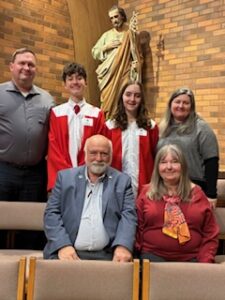
On the feast of Saint Joseph (March 19th), my husband Jeff and I were at Sacred Heart Church (Mount Holly, NJ) for the Confirmation service for our twin grandchildren (Zofia and Nathan), who were among the 50 students to receive the sacrament this year. For their 8th grade year, Jeff (a.k.a. Grandpa) was their catechist! On their own, they chose Clare and Francis as their Confirmation names. As their sponsors, we received a special gift from the parish catechetical team—a beautiful commemorative card with the title “The Role of the Sponsor.”
Before the service, I opened and read my card, which included an inscription of our granddaughter’s name and the date that she was sealed with the Holy Spirit—on the feast of Saint Joseph– the patron saint of my paternal grandfather, home parish, grammar and high schools, and university! It was a day that the Lord had made for us. Although the words inside the card highlighted the role of the sponsor, I thought that everyone who lives the faith with joy and conviction shares in this kind of witness for Christ:
“You have the honor of being chosen as witness to the confirmand’s initiation into full Christian life. Through this sacrament, the confirmand is strengthened by the power of the Holy Spirit, made a true witness of Christ in word and deed, and invited more deeply into the life of the Church. Your most significant role in relation to him/her is to be a role model of such witness and unifying love.
Some ways in which you can nurture this spiritual relationship all through life are:
- Celebrate the anniversary of this holy day of Confirmation with a visit, call, or card.
- Listen to and share in the confirmand’s maturing struggles and triumphs in living a Christian life and keep yourself informed on Christian doctrine and values to be able to answer questions when they arise.
- Encourage a maturing life of faith through special cards, letters, or gifts which celebrate holy events…Christmas, Easter…and personal growth events…graduations, first job, engagement. (Gift suggestions: a Bible, rosary, spiritual book, religious jewelry, retreat opportunity).
- Most importantly, become a model of Christian living for the person you have sponsored, through daily prayer, virtue, and active participation in parish life and liturgy.”
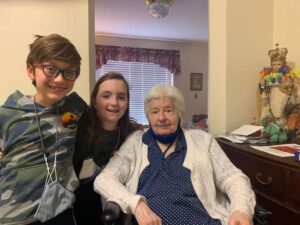
During the Confirmation service, I felt especially close to my own late sponsor (my Dad’s youngest sister), Cioci (Aunt) Irene, who passed away at age 95. Not only was she a great influence on my spiritual life, but she also played a large role in the lives of my four children even into their adult lives and with my twin grandchildren, who accompanied me on many visit to her assisted living facility.
When Cioci Irene passed away in July 2022, her son asked me to offer the words of remembrance at her Mass of Christian Burial. I had to smile inwardly when I spoke with the parish staff on the phone about the instructions: make sure that the words have spiritual content to them. Besides my grandparents and parents, my aunt was the greatest spiritual companion in my life for another 10 years after all of them had passed away.
I reread what I had written about Cioci Irene after I received that card at the Confirmation service. In my special memories of the “saint” that God had chosen to be my sponsor, I treasured how she: took away my fear of the bishop when I was confirmed; was the first to send me Polish wafer bread (opⱡatek) when I went away on active duty in the USAF; used her butter mold to make lambs for our family for the blessing of Easter food on Holy Saturday (and gave me her mold to continue the tradition); brought holy water to the parish cemetery for all of us to sprinkle as we bid farewell to her husband (my uncle); gave her treasured sodality rosary to my granddaughter with the instruction to pray it often; and always gave us a blessing on our foreheads when we left our visits with her, even if we were in the dining room and everyone could see it.
As we remember our Baptism during the Easter season, let us delight in the awe and wonder of God’s glory in new life that we experience in Christ. Let us remember those who have been witnesses of faith for us:
“…let us rejoice and be glad.”
Teresa S. Redder, OFS
Saint Katharine Drexel Regional Minister
Posted By Teresa Redder, on February 25th, 2026 This reflection is on the Scripture readings from the Sixth Sunday in Ordinary Time (February 15, 2026)
Joyful Gospel Living
“If you choose, you can keep the commandments…”
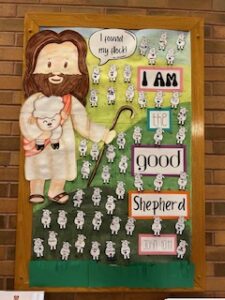
Over the past several weeks, the 2nd and 8th grade students in our parish have been preparing for the sacraments of First Holy Eucharist and Confirmation by participating in the sacrament of reconciliation. It is a grace-filled time, not only for the students who are in formation, but also for their families. Even the bulletin board in our church vestibule celebrates this spiritual journey as we look upon the cut-out sheep who are in the gentle care of the Good Shepherd.
During the prayer services before the private confessions, Fr. John (our pastor) proclaimed different Gospel parables to the two groups: the Prodigal Son (8th grade) and the Good Shepherd (2nd grade). In his homilies, Fr. John impressed upon the students how great is the love of God for every person. Even when we choose to do wrong, God seeks our return with mercy, compassion, kindness, and joy.
For most Catholics, our sacramental preparation required us to learn the Ten Commandments and to understand how they provide us with the framework for our daily lives. When the Ten Commandments are portrayed as two stone tablets, there are three commandments that refer to the love of God on one stone; the other stone has the seven commandments that direct us to love our neighbor. In the first reading from the Book of Sirach, there is a wisdom that is shared across all generations: “If you choose, you can keep the commandments; they will save you.”
As human beings made in the Divine image, we are blessed with the gift of free will and intellect. Through humility, we learn to use these gifts with great love for God and one another. The word “choose” is significant for us. The Ten Commandments provide us with a moral framework to build genuine relationships with God and our neighbors. During the reconciliation services, I always enjoy hearing the communal recitation of the Act of Contrition in which we publicly acknowledge that sometimes our choices are not always loving or the best for our spiritual lives. God is always waiting for us to come back. ♥
In the Catechism of the Catholic Church, the Church provides us with clear teaching about the basics of our faith. It has four main parts:
- One: The Profession of Faith (the Creed)
- Two: The Celebration of the Christian Mystery
- Three: Life in Christ
- Four: Christian Prayer
https://www.vatican.va/archive/ENG0015/_INDEX.HTM
Sometimes, it is worth it to spend some time exploring what the Church teaches. In Part Three of the Catechism (Life in Christ), there are two sections:
- Man’s Vocation in the Spirit;
- The Ten Commandments.
Both of these are related to the Scripture readings we have heard in these weeks of Ordinary Time. Our vocation in the Spirit is to embrace the charity described by the Beatitudes. They form our actions and our attitudes. Keeping the commandments then becomes our choice to love God and one another.
Through parish music ministry, I have participated in many reconciliation and sacramental events for our students over the years. For the second graders, their preparation time includes learning the song “Open My Eyes.” It is such a simple song, but it is full of a prayerful longing to know God better.
This year, our twin grandchildren (age 14) are receiving the sacrament of Confirmation on March 19th at Sacred Heart. The confirmandi had to prepare activity packets to reflect on their formation journey. Part of the packet required the logging of service hours, with a mapping to the corporal and spiritual works of mercy. When we are obedient to God by choosing to do good, we are led by the Holy Spirit to a life of service for others. It was fun to review the list of service hours with them and to see how they might be fruits of the works of mercy. Those choices are important to making God’s Kingdom visible now..
Another reflection activity was to think about their favorite story about Jesus and why it made an impression on them. This was a very personal encounter with Christ. When all of the responses are submitted, we can only imagine the beauty of the encounters that the confirmandi have had with Jesus as they have prepared to receive the sacrament. Which of the stories is important to our own lives at this time?
In our parish hymnal (Oregon Catholic Press), there is a song called “Eye Has Not Seen.” It is based on the epistle of St. Paul to the Corinthians that we heard this weekend: Eye has not seen, ear has not heard, what God has ready for those who love Him. The words to this song express the wonder and mystery of our God at work in our lives. It beseeches the Holy Spirit to give us the mind of Jesus so that we may learn to love the way that Christ loves. How that love transforms our world!
Over the next two months, the children in our parish will experience God’s love in the reception of the sacraments of initiation: Confirmation and Eucharist. Let us share their joy and learn about wonder from them:
“You have revealed to little ones the mysteries of the Kingdom.”
Teresa S. Redder, OFS
Saint Katharine Drexel Regional Minister
|
Formation Resources
Justice, Peace and Integrity of Creation (JPIC)
Local Fraternity Websites
Monthly Communications
Other Resources
Regional Handbook
Upcoming Events
|