

Joyful Gospel Living
“Seek the Lord, all you humble of the earth…Seek justice, seek humility.”
During the years that I served in the Air Force Reserves and participated in monthly weekend training assemblies, I had the opportunity occasionally to attend Mass at the base chapel. Just as our parish has worship aids that inspire our liturgical celebrations, the chapel also had liturgical art that enhanced the assembly’s prayer experiences. There was a large banner that hung near the altar that said, “Seek peace and pursue it.” This partial quote came from Psalm 34:14, which began with the instruction “Turn from evil, and do good.”
While reading the text from the Prophet Zephaniah this weekend, we hear him speaking to the people of God to “seek the Lord, all you humble of the earth…seek justice, seek humility.” Those words reminded me of those many weekends in the base chapel when I looked at the banner and prayed over the pursuit of peace in our world. In the face of evil in the world, we are called to do good. The good that we seek is justice, always remembering that every person is made in the Divine image and has equal dignity.
There was an important Synod of Bishops that met and subsequently issued a document on November 30, 1971, called “Justice in the World.” During their time together, the bishops addressed many global issues, such as technology; the right to development; migrants; the arms race;’ nationalism; racial and class divisions; and the concentration of the world’s wealth. Fifty-five years later, many of these same issues remain a challenge in our world for all those who seek justice. New ones have been added.
In his Message for the World Day of Peace in 1972, Pope St. Paul VI chose the title “If You Want Peace, Work for Justice.” In opening this document on the Vatican website, I felt a distinct affection for the Holy Father while reading his respectful salutation in the message: “Men of thought! Men of action! All mankind living in 1972!” The Holy Father wanted to reiterate what the bishops had recently summarized after their synod, giving hope to the world:
“It is an invitation which does not ignore the difficulties in practicing Justice, in defining it, first of all, and then in actuating it, for it always demands some sacrifice of prestige and self-interest: Perhaps more greatness of soul is needed for yielding to the ways of Justice and Peace than for fighting for and imposing on an adversary one’s rights, whether true or alleged. We have such trust in the power of the associated ideals of Justice and Peace to generate in modern man the moral energy to actuate them, that we are confident of their gradual victory. Indeed, we are even more confident that on his own modern man has an understanding of the ways of peace, sufficient to enable him to become a promoter of that Justice which opens those ways and sets people travelling them with courageous and prophetic hope.”
In this weekend’s Gospel, Jesus instructed His disciples with a blueprint for what makes God’s Kingdom a reality here and now, by citing the blessings of those who act as God desires. Whenever I read them, I like to hear the “If…then” implications of what Jesus is saying. For example, if you want mercy to be shown to you, then you must first be merciful as God teaches us. My favorite “If…then” is this Beatitude: If you want to be called God’s children, then you must be a peacemaker. From our baptism, we have been chosen to be God’s children by name. It is our baptismal call to be peacemakers. In our daily living, how are we working for justice as St. Paul VI urged us to do?
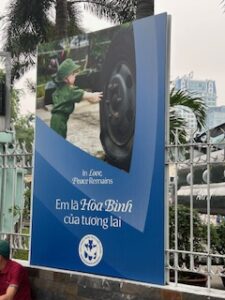
Recently, my husband Jeff and I had the opportunity to visit both Viet Nam and Cambodia. In both countries, there was evidence of great recovery by the people from the terrible atrocities of long warfare. The people that we met during our visit were kind, friendly, curious, and very proud of their long heritage.
On one of our excursions in Cambodia, we visited a “Killing Fields” site where the Khmer Rouge executed innocent civilians as part of a terrible genocide that saw the annihilation of almost one-third (3 million) of the Cambodian population. As we toured the infamous S21 prison where people were tortured to obtain confessions, our tour guide explained to us that, when the leaders of the Khmer Rouge were finally brought to trial, the Cambodian people did not seek or value revenge as a form of justice. There were no executions of Khmer Rouge after the trials.
For five decades, the Cambodian people have found healing through the four sublime states of Buddhism, the predominant religion of Cambodians: loving kindness, compassion, sympathetic joy, and equanimity. These same values are also integral to our Christian way of life. What are the possibilities in the world when people of goodwill work together to promote a more fraternal world? What resolve is necessary to turn from the subtle seductions of evil to do good?
When the Synod of Bishops met in 1971, there were wars in Southeast Asia, civil wars in Central and South America, and tensions in Africa as countries emerged from colonialism. While those are now part of history, different challenges in our world now urge us to seek justice so that there will be peace. The Beatitudes inspire us to live life with the same passion as Jesus, who showed us the way:
“Blessed are the peacemakers, for they will be called children of God.”
Teresa S. Redder, OFS
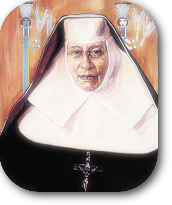
Saint Katharine Drexel Regional Minister
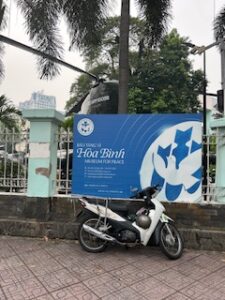
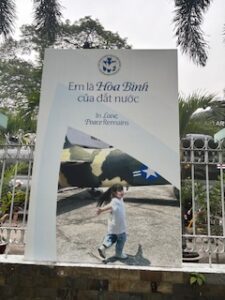
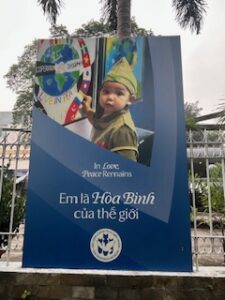
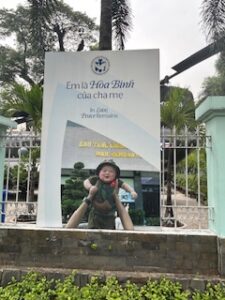
At the entrance to the War Remembrance Museum in Ho Chi Minh City (Saigon), Viet Nam
(Photos taken by Teresa Redder, OFS, in January 2026)
“In love, peace remains.”