

Joyful Gospel Living
“Then you shall be radiant at what you see…”
Unlike Advent, Lent, and Easter, the Christmas season is not very long in days of celebration: Christmas Eve vigil mass (December 24th) until the Baptism of the Lord (January 11th). During those 19 days, though, we hear some of the most wondrous stories of all time and we meet some of the most unlikely people who opened themselves to being part of God’s extraordinary plan for our salvation.
Whenever I listen to or play Christmas carols on the piano, I hear those stories so clearly. These are not the catchy holiday tunes that have played on the radio since Halloween and disappeared the day after Christmas. The true Christmas carols draw from us the desire to experience awe and wonder about the birth of Christ (although King Herod’s reaction, motivated by pride and envy, had no room for awe and wonder). Here are some noteworthy words from the carols that connect us to people and places: Bethlehem; stable and manger; heavenly host; shepherds and sheep; “Gloria in excelsis Deo”; a guiding star; Magi from the East; treasures of gold, frankincense, and myrrh; and the appearance of the Light of the world, transforming our world with His grace, peace, and beauty.
When my three brothers and I were growing up in Camden, the celebration of Epiphany always occurred on January 6th (before Vatican II). Our faith community looked forward to this celebration because our parish distributed chalk and incense for families to take home to bless their homes for the year ahead. Someone from the family would remind everyone of the three kings (Kaspar/Caspar, Melchior, and Balthasar) and then make an inscription above the doorframe: “20+K+M+B+26.” My Mom would bring out a special bowl with the resin of the incense, lighting its fragrance within each room for the same blessing for our house.
These special traditions help us to appreciate how wondrous it was that the Magi saw the bright star in the sky and followed it to where it led them. These faraway visitors to the newborn King in Bethlehem were the fulfillment of ancient scriptural prophecies in which every nation on earth would adore the Lord. This would become dramatically apparent later when St. Paul had his conversion and chose to bring the Good News to the Gentiles as the Church grew in faith and witness.
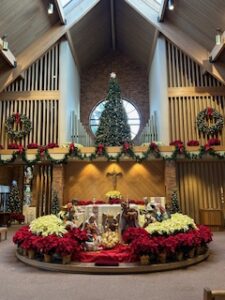
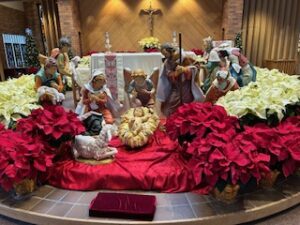
During the Christmas season, our worship area is beautifully decorated with the large Fontanini Nativity set and the significant characters in the birth of Christ. When we pause in front of that Nativity set, we understand what the Prophet Isaiah meant when he foretold, “Then you shall be radiant at what you see.” What a privilege to have been present during that wondrous moment! Sacred art enables us to have a taste of what it must have been like.
Our parish Nativity set not only has the Holy Family, offering us their love for one another and God, but also shepherds, animals, and the Magi. The story would not be complete without all of them. Isn’t it interesting that the visit of the Magi is not found in any other Gospel account other than Saint Matthew’s? Let us be grateful that this story and its consequences (the slaying of the Holy Innocents and the flight into Egypt are also significant to the Christmas season) were preserved so that we would understand that Christ’s coming was not totally idyllic and safe.
After more than two years of steady conflict, the Church welcomed Franciscan Fr. Francesco Ielpo, OFM, as the new Custos of the Holy Land. In a true spirit of interfaith dialogue, religious leaders resumed their annual celebration of Hanukkah with Christians and Muslims in Ein Karem, the home village of Zechariah, Elizabeth, and John the Baptist, followed by a Magnificat Institute concert that expanded dialogue to include Muslims. What a special way to bring light and hope to others!
In his first Christmas message as Custos, Fr. Ielpo focused on this Scripture quote: “She gave birth to her firstborn son, wrapped Him in swaddling clothes, and laid Him in a manger.” (Lk 2:7). The foreign Magi saw this, too:
“Jesus is born in a makeshift place, humble and unsuitable. The disruptive image of Christmas is smallness. Here in Bethlehem we contemplate a small God. A stable becomes the place of the infinite. The holiest liturgy is celebrated on straw, with the sharp smell of manure, in the caresses of a mother and in the cry of a child. Once again, Jesus is not afraid to descend to the lowest point of our humanity, made of violence, sin, pain, tears, and hardship. Once again, He is born and asks us, just as we are, to be a cradle for Him, with the poor straw of our fragility. He is laid in the manger to become food, nourishment of hope for all humanity. By looking at Him, contemplating Him, and imitating Him, we can begin again with renewed hope. In the stable of humanity, we are not alone. Jesus is born for us.”
The Prophet Isaiah reminded Jerusalem that they were part of God’s plan: even when darkness covered the earth, the glory of the Lord shone upon them because the light had come for them. On this Epiphany celebration, we share such glad tidings of joy and peace 2025 years later. If we pause to savor what has happened, we will experience what Isaiah foretold. May awe and wonder fill our days!
“…your heart shall throb and overflow.”
Teresa S. Redder, OFS
SKD Regional Minister

