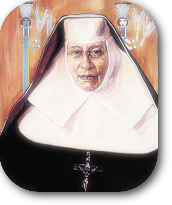
St. Katherine Drexel Regional Fraternity
Regional Spiritual Assistant
St. Francis of Assisi Friary
1901 Prior Road
Wilmington, Delaware 19809
tel: (302) 798-1454 fax: (302) 798-3360 website: skdsfo email: pppgusa@gmail.com
May 2026
Dear Sisters and Brothers in St. Francis of Assisi,
The Paraclete of Divine Presence, The Pardon of Divine Mercy, The Peace of Divine Love
Be the Easter Gifts that remain forever in your hearts,
with Mary’s Motherly Love to encourage you.
The Month of May always rekindles in the heart the loving devotion the Church has always expressed for Mary, Mother of Jesus and our Holy Mother. The saints of “both lungs” of the Mystical Body of Christ, the Church of our Eastern Rite and Orthodox sisters and brothers as well as we of the Western Roman Rite Church have praised our Most Blessed Mother in so many ways. In the Northern part of the World, May speaks of new life, rebirth, beauty of God’s kaleidoscope of colors in nature. The Paschal Mystery of Easter-Pentecost that celebrates the Church born from the side of Christ and our Mother Mary, birthing us in her Faith as She accepted the “impossible” and brought centuries of anticipation to an end with the mystery of the Virgin-Birth of Jesus.
Is it any wonder that St. Francis of Assisi, our Seraphic Father, the Poverello of Assisi, should be “overwhelmed” just by the thought of the Incarnation of Jesus, the unique collaboration of Mary, and how She, one of us, becomes the “Virgin-Made-Church”. The title given by Francis is uniquely Hers, but we share with our Mother. For in Faith, through Baptism, especially when we receive the Eucharist bring the Lord into the secret recesses of our body and soul (the Tabernacle) and then, by grace and the prompting of the Holy Spirit, Manifest Him to the world as we live the One we have sought to become in the Eucharist – Conformity to Christ, one with Christ, is living Jesus.
Mary is the highest honor of our race and greatest example among human beings of all this. She gave birth to Jesus in the secret of her womb when She gave her unconditional “Yes” to God’s request through the Archangel Gabriel. Thus She became the first true Tabernacle of the hidden and Real Presence. Yet, almost immediately, Mary becomes the First Monstrance and shows and offers Jesus, born in the poverty of Bethlehem, to poor Shepherds, wealthy Magi, ancient Temple Rites, up to the ultimate moment when a Mother offers Her Son to the Eternal Will of the Father as Her Son hung upon the Cross. To the end, Mary said “Yes” without hesitation, regardless of the personal price placed on a Mother’s Heart.
Is it any wonder that St. Francis of Assisi should express such love and praise for Mary in his life and to the religious Family God inspired him to initiate. An interesting expression St. Francis used in a prayer recited daily as an introduction to his Office of the Passion greets Mary as Virgin-Made-Church.
St. Francis of Assisi had a way of speaking about holy things that felt less like a scholar lecturing and more like a friend pointing out something beautiful you might have missed. His title for Mary—“the Virgin made Church”—is one of those phrases that sounds simple at first, almost like a poetic flourish, until you sit with it long enough for its layers to unfold. Francis was not trying to invent a new Marian doctrine. He was trying to express something he had seen in prayer, something that had seized his heart: that Mary, in her very being, shows us what the Church is meant to be. And he said it in the way he said most things—directly, humbly, and with a kind of spiritual common sense that makes you wonder why you never thought of it that way yourself.
When Francis calls Mary “Virgin,” he is not merely referring to a biological fact. He is pointing to her radical openness to God, her uncluttered interior space, her freedom from anything that would block the divine initiative. Virginity, for Francis, is about availability. It is about being so empty of self‑assertion that God can do something new in you. And when he calls her “Church,” he is not thinking of an institution or a hierarchy or even a community in the sociological sense. He is thinking of the Church as the place where Christ becomes present in the world. Mary is the first to receive Christ, the first to bear him, the first to give him to others. In her, the mystery of the Church begins in miniature.
Often, in households of the past, those who cooked for the family had special containers for specific items – and God help anyone who used them for anything else. These items were never used unless for the purpose they were intended. These jars or whatever, were always empty, not because they were not to be used but because they were ready for the day required—mixing dough, holding fruit, catching vegetables from the garden. Mary is like that container. She is empty so she can be filled, and she is filled so she can be given. That is the kind of image Francis would have loved. Mary’s virginity is not a static purity but a dynamic readiness. Her motherhood is not a private privilege but a public gift. And the Church, if it is to be what it claims to be, must learn from her.
Francis saw this connection most clearly in the mystery of the Incarnation. For him, the whole Christian life begins with the astonishing fact that God chose to become small. He loved to meditate on the humility of Christ in the manger, the vulnerability of God wrapped in swaddling clothes. And he understood that this humility was not only Christ’s but Mary’s as well. She allowed God to become small in her. She made room for the infinite. She let the Word take flesh. In that sense, she is the prototype of every believer. What happened in her physically must happen in us spiritually. Christ must be conceived in us, grow in us, and be brought forth into the world through our actions. That is why Francis can say that we, too, are mothers of Christ when we carry him in our hearts and give birth to him through our works of love.
Years ago, a Franciscan sister described Mary’s virginity in a way that would have made Francis smile. She said that Mary’s virginity was like the silence before a beautiful piece of music begins. It wasn’t emptiness for its own sake. It was a space charged with expectancy, a readiness for something divine to break in. That is how Francis understood virginity, not as a negation but as a capacity, a freedom from anything that would crowd out God’s voice. Mary’s virginity was the soil in which the Word could take root. And the Church, if it is to be faithful, must cultivate that same interior spaciousness.
Mary is the first and fullest example of this mystery, and so she becomes the mirror in which the Church sees its own identity. When Francis calls her “Virgin made Church,” he is saying that the Church is most itself when it resembles Mary, when it listens before it speaks, receives before it acts, treasures the Word before it teaches it. The Church is not primarily a structure or a system but a womb, a place where Christ can take flesh again and again in the lives of believers. Mary shows us what that looks like in its purest form.
For Francis, the Incarnation was not a distant event. It was something he expected to see traces of everywhere—in the poor, in the Eucharist, in the fragile beauty of creation, and especially in the maternal tenderness of Mary. She was the one who first held the mystery, and she continues to hold it in the life of the Church. To call her “Virgin made Church” is to say that the Church is born from her yes, shaped by her faith, and sustained by her example.
This title also carries a challenge. If Mary is the model of the Church, then the Church must imitate her humility, her poverty of spirit, her willingness to let God lead. Francis was never shy about reminding Christians of this. He believed the Church becomes less itself when it becomes self‑protective, self‑important, or self‑sufficient. Mary shows another way. She does not cling to control. She does not seek status. She simply receives, trusts, and gives. And in doing so, she becomes the dwelling place of God.
Francis probably loved this title because it kept the Church grounded. It reminded believers that holiness is not complicated. It begins with listening, with making space, with saying yes to God in the ordinary circumstances of life. Mary did not perform miracles or preach sermons. She welcomed the Word. She carried him. She offered him to the world. That is the heart of the Church’s mission, and it is the heart of every Christian’s vocation.
Calling Mary “the Virgin made Church” is not just a theological statement. It is an invitation. It invites the Church to rediscover its identity not in power or prestige but in humility, receptivity, and maternal love. It invites each believer to become a place where Christ can dwell. It invites us to say yes to God in the concrete circumstances of our lives, just as Mary did in hers.
Francis knew that the Church is always in need of renewal. But he also knew that renewal does not begin with strategies or structures. It begins with holiness. It begins with hearts that resemble Mary’s, open, trusting, and ready to receive Christ anew. Mary is the Church in its purest form, and the Church becomes more itself the more it becomes like her.
In the end, “Virgin made Church” is Francis’s way of saying that Mary is not just the mother of Jesus; she is the mother of all who belong to him. She is the first home of Christ and the first image of what his home on earth, the Church, is meant to be. And like all good mothers, she teaches not by demanding but by embodying. She shows us what it looks like to let God’s life unfold in us. She shows us how to become, in our own small way, a place where Christ can be born again.
May Mary, Virgin-Made-Church and thus Mother of the Church, accompany us through life’s journey. We take refuge in Her Motherly embrace as we seek to conform ourselves to the image and likeness of Her Son. We are the Church called to be the Mystical Body of Christ and Heralds of Hope who “Live Jesus” that He may be alive in all who accept Him as Lord and Savior, and that they proclaim with Thomas: “My Lord and My God!”.
Peace and Blessings
Fr. Francis A. Sariego, O.F.M. Cap.
Regional Spiritual Assistant

