|
|
Posted By Teresa Redder, on May 9th, 2026 Joyful Gospel Living
“Come to Him, a living stone…chosen and precious in the sight of God.”
Background:
Like many other fraternities, our local fraternity (Holy Assumption-Roebling, NJ) prayed that we might find a common apostolate. At the suggestion of one of our members, we decided that this should be a pro-life apostolate. After exploring several options in our local area, we made arrangements to meet Clare Kirk, OFS (belonged to St. Peter Fraternity in Riverside, NJ) , who worked at Good Counsel Home in Riverside with expectant and new mothers. She gave us a tour of the facility and what the needs were. Later, she visited our fraternity and spoke to our membership about this life-giving ministry. In a follow-up phone call, Clare mentioned to me that there was an even greater need to assist the mothers after their two years of association with the home, when their life skills were put to the test and they sometimes struggled to adjust. At that time, Clare maintained contact with seven alumnae (new mothers) who were trying to make a life for themselves and their new babies. Our fraternity made a commitment to help one of those mothers (Emma) and her 18-month old baby Essence. It has been a wonderful journey of accompaniment for all of us. This June, Essence will be 14 years old and graduating from 8th grade!
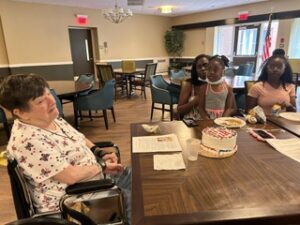
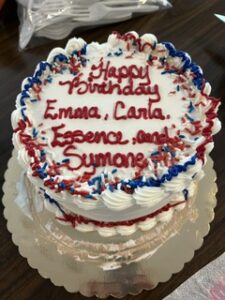
One of our fraternity members has been at the Masonic Village in Burlington, NJ, for many years now. Every year, we take fraternity to Carla to celebrate her birthday (June 29th). Emma and Essence celebrate birthdays in May and June respectively, so Carla gets to enjoy a triple celebration. How special will the visit be this year! Little sister Symone’s birthday is in September, but she gets to party, too. Carla looks forward to these visits and lavishes affection on Emma and the girls.
Reflection:
A few years ago, my husband Jeff and I made a trip to the White Mountains of Maine to visit one of my brothers and his wife. They live on Mt. Abram, but their home provides easy access to the Presidential range in New Hampshire and the Appalachian Trail (AT) as it crosses into Maine. One day, we decided to take a hike on the AT and found a trailhead to Table Rock, famous locally for the spectacular views when reaching the summit. As we hiked the rugged trail, we encountered the characteristic terrain details of Maine: stones, rocks, and boulders! When we were about 2/3 of the way up, we were both envious of bighorn sheep and their abilities to traverse such terrain!
What does a living stone look like? In St. Peter’s epistle, he encourages the local Church to “Come to Him, a living stone, rejected by human beings, chosen and precious in the sight of God.” This was an appeal to people of faith to turn to the Light of Christ and have a desire to be a living stone to build up the Church as a visible sign of Christ’s presence in our world.
On April 14th, the Franciscan Action Network (FAN) hosted a one-hour webinar to encourage people of faith to advocate for a just Farm Bill. This important legislation not only protects the needs of farmers who raise the food that will nourish our country and people in faraway lands, but it also funds the Supplemental Nutrition Assistance Program (SNAP) and The Emergency Food Assistance Program (TEFAP). Both of these programs are critical to the life and dignity of people affected by poverty.
From dialogue with the coordinators at FAN, I knew that their promotion of advocacy was to get constituents to write to the members of Congress to make it a priority to preserve funding for those who are in need. When the One Big Beautiful Bill was passed last fall, there was intention to cut $30B of SNAP funding over the next decade. The proposed budget for FY2027 includes a $4.9B reduction to SNAP. What must a living stone do to build the spiritual house whose cornerstone is Jesus Christ? These reductions have a direct impact on struggling families like Emma’s.
I visited the Catholic Charities USA website to see what the impact has been. In recent news, I found a link to a letter to the Senate Committee on Appropriations by Kerry Alys Robinson, the President and CEO of Catholic Charities USA, in which she wrote on behalf of the 169 diocesan Catholic Charities agencies in the US to make an urgent appeal for the vulnerable in our society:
https://www.catholiccharitiesusa.org/wp-content/uploads/2026/04/letter-appropriations-labor-hhs-fy2027.pdf
In the introduction to her letter, Robinson wrote:
“As you consider the Fiscal Year 2027 Labor, Health and Human Services, and Education (Labor-HHS) appropriations bill, Catholic Charities USA (CCUSA) urges you to invest in programs that protect and support poor and vulnerable children, seniors, families, people facing behavioral and mental health crises, workforce development and training.”
As living stones, we can choose to place ourselves where we intentionally build a strong structure. The Gospel teaches us how we are to live by loving one another and following the example of Jesus in seeing Him in one another. In this weekend’s Gospel from St. John, Jesus tells His followers: “Amen, amen, I say to you, whoever believes in Me will do the works that I do, and will do greater ones than these, because I am going to the Father.”
What is ours to do? In our parish life, we know that there is a ministry to those in need through the efforts of our St. Vincent de Paul Society. Many people come to our food pantry for temporary and sustaining assistance. In many cases, many of those families also receive SNAP benefits, but they do not cover the growing expenses of our world today. As draconian cuts are made to these critical benefits, how will families cope? What must living stones do for one another? How does our faith in God inspire us to do the work as Christ, our foundation, would?
For 13 years, our Secular Franciscan fraternity has accompanied a young single mother and her two daughters as a pro-life ministry. Through this accompaniment, we have learned a great deal about the difficulties that poor people face with the very basics of society: food nourishment; affordable housing; sources of basic material needs such as clothing, furniture, public transportation, legal protection; and serious safety concerns when living and working in dangerous areas. These experiences are part of an ongoing conversion for those who sincerely want to be living stones for Christ.
When Pope Francis released his encyclical Fratelli Tutti in 2020, I explored the Catechism of the Catholic Church (CCC) using the search engine for “common good” and found 73 results. In Part Three (Life in Christ), there was a resonating teaching for living stones:
“Freedom is exercised in relationships between human beings. Every human person, created in the image of God, has the natural right to be recognized as a free and responsible being. All owe to each other this duty of respect, the right to the exercise of freedom, especially in moral and religious matters, is an inalienable requirement of the dignity of the human person. This right must be recognized and protected by civil authority within the limits of the common good and public order.” (CCC, 1738)
The Beatitudes are our blueprint for building the Kingdom of God here and now. Jesus teaches us that God’s reign is visible where people respond to the needs for righteousness and justice with mercy and compassion. There are so many needs in our world today. Sometimes, there can be a global impact by a singular event (e.g., the Chernobyl nuclear disaster). Every person of faith is called to be a living stone, and then it is good to:
“…let yourselves be built into a spiritual house.”
Teresa S. Redder, OFS
Saint Katharine Drexel Regional Minister
Posted By Teresa Redder, on April 26th, 2026 On Sunday, April 26, 2026, Saint John the Evangelist Fraternity held a Chapter of Elections at St. John the Evangelist Parish Center in Philadelphia, PA. The presider was Teresa Redder, OFS (Regional Minister) and the ecclesial witness (delegate) was Fr. John McCloskey, OFM Cap.
It is such a great joy to see the election of two newly professed members (Adriano and Victor) to the Fraternity Council with a great desire to serve the Lord with gladness.
We give thanks to God for all of these newly elected servant leaders of this local fraternity. May God continue to bless them with the fidelity to serve with great humility!
| COUNCIL POSITION |
MEMBER |
NOTES |
| Minister |
Carolyn Murray, OFS |
Reelected |
| Vice Minister |
Terry Guerra, OFS |
Newly elected |
| Secretary |
Adriano Duque, OFS |
Newly elected |
| Treasurer |
Bob McKee, OFS |
Newly elected |
| Formation Director |
Venus Murphy, OFS |
Reelected |
| Councilor-at-Large |
Víctor Sanchez, OFS |
Newly elected |
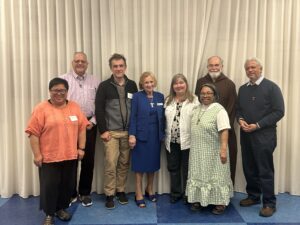
Left to right: Terry Guerra, OFS; Bob McKee, OFS; Adriano Duque, OFS; Carolyn Murray, OFS; Teresa Redder, OFS; Venus Murphy, OFS; Fr. John McCloskey, OFM Cap; and Victor Sanchez, OFS.
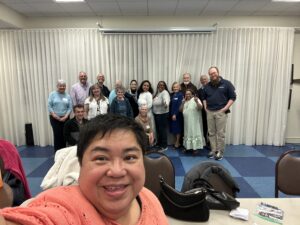
The fraternal gathering concluding with Franciscan joy…
and the inquirers who were present had a peek at what a Chapter of Elections looks like!
Posted By Teresa Redder, on April 26th, 2026 JOYFUL GOSPEL LIVING
April 5, 2026 – The Resurrection of the Lord
“This is the day the Lord has made…”
At the Easter Vigil, my parish welcomed four catechumens into the Church through baptism. During this long liturgy, all of the faithful experienced the awe and wonder of Christ’s Resurrection through powerful symbols (fire, light, water, and oil), the chanting of the glorious Exsultet, special Scripture readings, and the rite of Christian initiation with water, candles, and chrism, followed by the reception of the Eucharist. This ritual is observed all over the world with the same reverence and glory that our faith has preserved by tradition for centuries.
For the catechumens and all of us, the celebration of Easter helps us to appreciate what Christ has promised to all of us who believe in Him and to share with Him the eternal life that He offers. Over three weekends in March, the catechumens participated in the weekend scrutinies of their faith. The symbols of Easter are profoundly present in our communal celebration:
- First Scrutiny: “I am the Living Water.”
- Second Scrutiny: “I am the Light of the World.”
- Third Scrutiny: “I am the Resurrection and the Life.”
Once a year, we renew our baptismal promises on Easter Sunday and then we are sprinkled with holy water to symbolize the new life that we share in Christ. As we are welcomed into God’s family as His sons and daughters at baptism, we also begin our journey of discipleship. For those of us who were baptized as infants, we relied on the examples of our parents, godparents, and other faith-filled people to shape our lives. When we are sprinkled with holy water, we should experience the incredible joy that Psalm 118 describes:
“This is the day the Lord has made.”
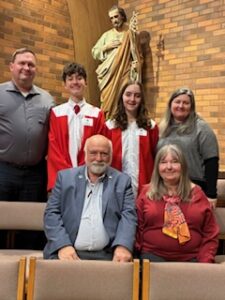
On the feast of Saint Joseph (March 19th), my husband Jeff and I were at Sacred Heart Church (Mount Holly, NJ) for the Confirmation service for our twin grandchildren (Zofia and Nathan), who were among the 50 students to receive the sacrament this year. For their 8th grade year, Jeff (a.k.a. Grandpa) was their catechist! On their own, they chose Clare and Francis as their Confirmation names. As their sponsors, we received a special gift from the parish catechetical team—a beautiful commemorative card with the title “The Role of the Sponsor.”
Before the service, I opened and read my card, which included an inscription of our granddaughter’s name and the date that she was sealed with the Holy Spirit—on the feast of Saint Joseph– the patron saint of my paternal grandfather, home parish, grammar and high schools, and university! It was a day that the Lord had made for us. Although the words inside the card highlighted the role of the sponsor, I thought that everyone who lives the faith with joy and conviction shares in this kind of witness for Christ:
“You have the honor of being chosen as witness to the confirmand’s initiation into full Christian life. Through this sacrament, the confirmand is strengthened by the power of the Holy Spirit, made a true witness of Christ in word and deed, and invited more deeply into the life of the Church. Your most significant role in relation to him/her is to be a role model of such witness and unifying love.
Some ways in which you can nurture this spiritual relationship all through life are:
- Celebrate the anniversary of this holy day of Confirmation with a visit, call, or card.
- Listen to and share in the confirmand’s maturing struggles and triumphs in living a Christian life and keep yourself informed on Christian doctrine and values to be able to answer questions when they arise.
- Encourage a maturing life of faith through special cards, letters, or gifts which celebrate holy events…Christmas, Easter…and personal growth events…graduations, first job, engagement. (Gift suggestions: a Bible, rosary, spiritual book, religious jewelry, retreat opportunity).
- Most importantly, become a model of Christian living for the person you have sponsored, through daily prayer, virtue, and active participation in parish life and liturgy.”
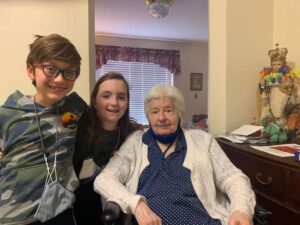
During the Confirmation service, I felt especially close to my own late sponsor (my Dad’s youngest sister), Cioci (Aunt) Irene, who passed away at age 95. Not only was she a great influence on my spiritual life, but she also played a large role in the lives of my four children even into their adult lives and with my twin grandchildren, who accompanied me on many visit to her assisted living facility.
When Cioci Irene passed away in July 2022, her son asked me to offer the words of remembrance at her Mass of Christian Burial. I had to smile inwardly when I spoke with the parish staff on the phone about the instructions: make sure that the words have spiritual content to them. Besides my grandparents and parents, my aunt was the greatest spiritual companion in my life for another 10 years after all of them had passed away.
I reread what I had written about Cioci Irene after I received that card at the Confirmation service. In my special memories of the “saint” that God had chosen to be my sponsor, I treasured how she: took away my fear of the bishop when I was confirmed; was the first to send me Polish wafer bread (opⱡatek) when I went away on active duty in the USAF; used her butter mold to make lambs for our family for the blessing of Easter food on Holy Saturday (and gave me her mold to continue the tradition); brought holy water to the parish cemetery for all of us to sprinkle as we bid farewell to her husband (my uncle); gave her treasured sodality rosary to my granddaughter with the instruction to pray it often; and always gave us a blessing on our foreheads when we left our visits with her, even if we were in the dining room and everyone could see it.
As we remember our Baptism during the Easter season, let us delight in the awe and wonder of God’s glory in new life that we experience in Christ. Let us remember those who have been witnesses of faith for us:
“…let us rejoice and be glad.”
Teresa S. Redder, OFS
Saint Katharine Drexel Regional Minister
Posted By Teresa Redder, on February 25th, 2026 This reflection is on the Scripture readings from the Sixth Sunday in Ordinary Time (February 15, 2026)
Joyful Gospel Living
“If you choose, you can keep the commandments…”
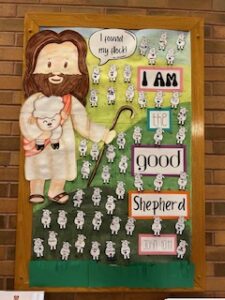
Over the past several weeks, the 2nd and 8th grade students in our parish have been preparing for the sacraments of First Holy Eucharist and Confirmation by participating in the sacrament of reconciliation. It is a grace-filled time, not only for the students who are in formation, but also for their families. Even the bulletin board in our church vestibule celebrates this spiritual journey as we look upon the cut-out sheep who are in the gentle care of the Good Shepherd.
During the prayer services before the private confessions, Fr. John (our pastor) proclaimed different Gospel parables to the two groups: the Prodigal Son (8th grade) and the Good Shepherd (2nd grade). In his homilies, Fr. John impressed upon the students how great is the love of God for every person. Even when we choose to do wrong, God seeks our return with mercy, compassion, kindness, and joy.
For most Catholics, our sacramental preparation required us to learn the Ten Commandments and to understand how they provide us with the framework for our daily lives. When the Ten Commandments are portrayed as two stone tablets, there are three commandments that refer to the love of God on one stone; the other stone has the seven commandments that direct us to love our neighbor. In the first reading from the Book of Sirach, there is a wisdom that is shared across all generations: “If you choose, you can keep the commandments; they will save you.”
As human beings made in the Divine image, we are blessed with the gift of free will and intellect. Through humility, we learn to use these gifts with great love for God and one another. The word “choose” is significant for us. The Ten Commandments provide us with a moral framework to build genuine relationships with God and our neighbors. During the reconciliation services, I always enjoy hearing the communal recitation of the Act of Contrition in which we publicly acknowledge that sometimes our choices are not always loving or the best for our spiritual lives. God is always waiting for us to come back. ♥
In the Catechism of the Catholic Church, the Church provides us with clear teaching about the basics of our faith. It has four main parts:
- One: The Profession of Faith (the Creed)
- Two: The Celebration of the Christian Mystery
- Three: Life in Christ
- Four: Christian Prayer
https://www.vatican.va/archive/ENG0015/_INDEX.HTM
Sometimes, it is worth it to spend some time exploring what the Church teaches. In Part Three of the Catechism (Life in Christ), there are two sections:
- Man’s Vocation in the Spirit;
- The Ten Commandments.
Both of these are related to the Scripture readings we have heard in these weeks of Ordinary Time. Our vocation in the Spirit is to embrace the charity described by the Beatitudes. They form our actions and our attitudes. Keeping the commandments then becomes our choice to love God and one another.
Through parish music ministry, I have participated in many reconciliation and sacramental events for our students over the years. For the second graders, their preparation time includes learning the song “Open My Eyes.” It is such a simple song, but it is full of a prayerful longing to know God better.
This year, our twin grandchildren (age 14) are receiving the sacrament of Confirmation on March 19th at Sacred Heart. The confirmandi had to prepare activity packets to reflect on their formation journey. Part of the packet required the logging of service hours, with a mapping to the corporal and spiritual works of mercy. When we are obedient to God by choosing to do good, we are led by the Holy Spirit to a life of service for others. It was fun to review the list of service hours with them and to see how they might be fruits of the works of mercy. Those choices are important to making God’s Kingdom visible now..
Another reflection activity was to think about their favorite story about Jesus and why it made an impression on them. This was a very personal encounter with Christ. When all of the responses are submitted, we can only imagine the beauty of the encounters that the confirmandi have had with Jesus as they have prepared to receive the sacrament. Which of the stories is important to our own lives at this time?
In our parish hymnal (Oregon Catholic Press), there is a song called “Eye Has Not Seen.” It is based on the epistle of St. Paul to the Corinthians that we heard this weekend: Eye has not seen, ear has not heard, what God has ready for those who love Him. The words to this song express the wonder and mystery of our God at work in our lives. It beseeches the Holy Spirit to give us the mind of Jesus so that we may learn to love the way that Christ loves. How that love transforms our world!
Over the next two months, the children in our parish will experience God’s love in the reception of the sacraments of initiation: Confirmation and Eucharist. Let us share their joy and learn about wonder from them:
“You have revealed to little ones the mysteries of the Kingdom.”
Teresa S. Redder, OFS
Saint Katharine Drexel Regional Minister
Posted By Teresa Redder, on January 7th, 2026 Joyful Gospel Living
“Then you shall be radiant at what you see…”
Unlike Advent, Lent, and Easter, the Christmas season is not very long in days of celebration: Christmas Eve vigil mass (December 24th) until the Baptism of the Lord (January 11th). During those 19 days, though, we hear some of the most wondrous stories of all time and we meet some of the most unlikely people who opened themselves to being part of God’s extraordinary plan for our salvation.
Whenever I listen to or play Christmas carols on the piano, I hear those stories so clearly. These are not the catchy holiday tunes that have played on the radio since Halloween and disappeared the day after Christmas. The true Christmas carols draw from us the desire to experience awe and wonder about the birth of Christ (although King Herod’s reaction, motivated by pride and envy, had no room for awe and wonder). Here are some noteworthy words from the carols that connect us to people and places: Bethlehem; stable and manger; heavenly host; shepherds and sheep; “Gloria in excelsis Deo”; a guiding star; Magi from the East; treasures of gold, frankincense, and myrrh; and the appearance of the Light of the world, transforming our world with His grace, peace, and beauty.
When my three brothers and I were growing up in Camden, the celebration of Epiphany always occurred on January 6th (before Vatican II). Our faith community looked forward to this celebration because our parish distributed chalk and incense for families to take home to bless their homes for the year ahead. Someone from the family would remind everyone of the three kings (Kaspar/Caspar, Melchior, and Balthasar) and then make an inscription above the doorframe: “20+K+M+B+26.” My Mom would bring out a special bowl with the resin of the incense, lighting its fragrance within each room for the same blessing for our house.
These special traditions help us to appreciate how wondrous it was that the Magi saw the bright star in the sky and followed it to where it led them. These faraway visitors to the newborn King in Bethlehem were the fulfillment of ancient scriptural prophecies in which every nation on earth would adore the Lord. This would become dramatically apparent later when St. Paul had his conversion and chose to bring the Good News to the Gentiles as the Church grew in faith and witness.
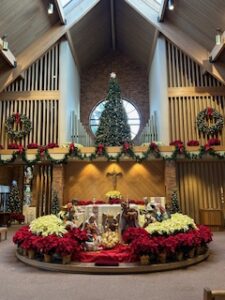
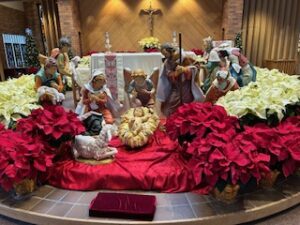
During the Christmas season, our worship area is beautifully decorated with the large Fontanini Nativity set and the significant characters in the birth of Christ. When we pause in front of that Nativity set, we understand what the Prophet Isaiah meant when he foretold, “Then you shall be radiant at what you see.” What a privilege to have been present during that wondrous moment! Sacred art enables us to have a taste of what it must have been like.
Our parish Nativity set not only has the Holy Family, offering us their love for one another and God, but also shepherds, animals, and the Magi. The story would not be complete without all of them. Isn’t it interesting that the visit of the Magi is not found in any other Gospel account other than Saint Matthew’s? Let us be grateful that this story and its consequences (the slaying of the Holy Innocents and the flight into Egypt are also significant to the Christmas season) were preserved so that we would understand that Christ’s coming was not totally idyllic and safe.
After more than two years of steady conflict, the Church welcomed Franciscan Fr. Francesco Ielpo, OFM, as the new Custos of the Holy Land. In a true spirit of interfaith dialogue, religious leaders resumed their annual celebration of Hanukkah with Christians and Muslims in Ein Karem, the home village of Zechariah, Elizabeth, and John the Baptist, followed by a Magnificat Institute concert that expanded dialogue to include Muslims. What a special way to bring light and hope to others!
In his first Christmas message as Custos, Fr. Ielpo focused on this Scripture quote: “She gave birth to her firstborn son, wrapped Him in swaddling clothes, and laid Him in a manger.” (Lk 2:7). The foreign Magi saw this, too:
“Jesus is born in a makeshift place, humble and unsuitable. The disruptive image of Christmas is smallness. Here in Bethlehem we contemplate a small God. A stable becomes the place of the infinite. The holiest liturgy is celebrated on straw, with the sharp smell of manure, in the caresses of a mother and in the cry of a child. Once again, Jesus is not afraid to descend to the lowest point of our humanity, made of violence, sin, pain, tears, and hardship. Once again, He is born and asks us, just as we are, to be a cradle for Him, with the poor straw of our fragility. He is laid in the manger to become food, nourishment of hope for all humanity. By looking at Him, contemplating Him, and imitating Him, we can begin again with renewed hope. In the stable of humanity, we are not alone. Jesus is born for us.”
The Prophet Isaiah reminded Jerusalem that they were part of God’s plan: even when darkness covered the earth, the glory of the Lord shone upon them because the light had come for them. On this Epiphany celebration, we share such glad tidings of joy and peace 2025 years later. If we pause to savor what has happened, we will experience what Isaiah foretold. May awe and wonder fill our days!
“…your heart shall throb and overflow.”
Teresa S. Redder, OFS
SKD Regional Minister
Posted By Teresa Redder, on December 3rd, 2025 “This is the King of the Jews.”
As I prayed over what reflection to share for the Solemnity of Christ the King, I could hear a song playing in my head that the Sacred Heart School students have sung at their monthly Masses: The King Shall Come (#70 in our parish hymnal). There is something so hope-filled and prayerful in the words of this song. It bothered me, though, that it was in the Advent section of our hymnal.
While on a Franciscan retreat (November 3-12) to Assisi, Italy, during which we spent nine days reflecting on the Journey into God by St. Bonaventure, my husband Jeff and I joined 30 other pilgrims from the US, Canada, England, Germany, and the Philippines to appreciate how contemplation leads us to God, the Summum Bonum (Highest Good).
On our fourth day together, our retreat leaders asked the group: How does the outside enter us? This was an important spiritual question for those whose desire was to be a lover of God. As we considered that question, we had help from St. Bonaventure regarding three powers of the psyche that are relational:
- Memory → eternity (the image of God);
- Intellect → Truth (meaning of words, sentences, logical conclusions);
- Will → Highest Good (deliberate, judge, desire).
In this chapter, St. Bonaventure wrote, “The function of the memory is to retain and represent not only things that are present, physical, and temporal, but also things that are successive, simple, and everlasting. Memory holds past things by recall, present things by reception, and future things by anticipation.” After reading that, I knew that the song I was hearing was meant for this reflection.
What does our memory tell us about our image of God? Do we understand who Christ the King is and where His Kingdom exists? Do we anticipate the coming of our King by remembering what Christ promised to us?
In this weekend’s first reading, we remember how David became king of Israel, anointed before the Lord to serve the people. Future prophets would later foretell that the Messiah would come from the royal line of David. The Jewish people held that hope in their memory. When Jesus came, though, it was not in the way people would imagine their King would come.
In the song The King Shall Come, the composer Trevor Thomson gives us a song about the King who has already been with us, but told us that He was returning. How are the faithful waiting and longing for that return? Do we see signs of the King in our midst?
The King shall come when morning dawns
and light triumphant breaks,
When beauty gilds the eastern hills
and life to joy awakes.
Not, as of old, a little child,
to bear, and fight, and die,
but crowned with glory like the sun that lights the morning sky.
This weekend’s Gospel account by St. Luke looks at the kingship of Christ through the lens of the Cross. Who would ever expect their king to be crucified by their oppressors? Part of the mockery that Jesus endured was to have the sign above His cross that said, “This is the King of the Jews.” For the people who journeyed with Jesus, this present situation challenged their memory. Nobody yet knew what was to come. One of the criminals that was executed with Jesus did understand it, though, and he asked Jesus to remember him when He entered into His Kingdom. Jesus promised Him that he would be with Him in paradise.
Through the Sacred Scriptures, our memory is able to recall the birth of Christ, the proclamation of the Kingdom, and the Passion of Christ. They are significant past events that shape our faith and our desire to know Christ better.
The people of God today live in much different circumstances than when Jesus preached the Good News. Technology continues to advance rapidly, sometimes with harmful effects on people. Major conflicts continue to erupt in the world that cause great human suffering. Seeing the face of Christ in our midst, a present memory, remains a challenge for all Christians because it requires the full embrace of the three theological virtues of faith, hope, and love.
The criminal who put his faith in Christ trusted that His Kingdom truly existed. Through memory, we know that the death of Jesus was not the end. The resurrection of Jesus was the King’s glory, witnessed by many people. How beautiful, then, is verse 2 of the song for those who believe and hope for the King:
O brighter than the rising morn
when He, victorious, rose
and left the lonesome place of death,
despite the rage of foes.
O brighter than that glorious morn
shall this fair morning be,
when Christ, our King, in beauty comes,
and we His face shall see!
Memory teaches us that the desire for God is something that should be with us daily, shaping our prayer life and our choices to think and act. This weekend, let us sing confidently…
“Come quickly, King of kings! Come quickly, King of kings!
The King Shall Come – Lyrics Video
May God bless our Advent with longing, joy, and hope for what we see and what we await!
Teresa S. Redder, OFS
Saint Katharine Drexel Regional Minister
Posted By Teresa Redder, on December 3rd, 2025 St. Katherine Drexel Regional Fraternity
Regional Spiritual Assistant
St. Francis of Assisi Friary
1901 Prior Road
Wilmington, Delaware 19809
tel: (302) 798-1454 fax: (302) 798-3360 website: skdsfo email: pppgusa@gmail.com
December 2025
O admirable heights and sublime lowliness! O sublime humility! O humble sublimity!
That the Lord of the universe, God and the Son of God,
so humbles Himself that for our salvation
He hides Himself under the little form of bread!
Look, brothers, at the humility of God and pour out your hearts before Him!
Humble yourselves, as well, that you may be exalted by Him.
Therefore, hold back nothing of yourselves for yourselves
so that He Who gives Himself totally to you may receive you totally.
Daily reminders from the sources are from the Assisi Compilation #82-#84
Quotes for each day from the works of C.S.Lewis
83 – BROTHER ELIAS AND CARDINAL HUGOLINO ASK HIM TO ACCEPT MEDICAL HELP HE COMPOSES THE CANTICLE OF BROTHER SUN AT SAN DAMIANO
1 – The Bishop of Ostia, who later became the apostolic bishop, seeing how blessed Francis was always severe with his body, and especially because he was rapidly losing his eyesight because he refused to have himself treated, admonished him with great kindness and compassion.
– You can’t go back and change the beginning, but you can start where you are and change the ending.
2 – He told him: “Brother, you do not do well in not allowing yourself to be helped with your eye disease, for your health and your life are of great value not only to yourself but also to others.
– When the whole world is running towards a cliff, he who is running in the opposite direction appears to have lost his mind.
3 – If you have compassion for your sick brothers, and have always been and still are merciful to them, you must not be cruel to yourself in such a serious and manifest need and illness. I therefore order you to allow yourself to be helped and treated.”
– Life with God is not immunity from difficulties, but peace in difficulties.
4 – Likewise, two years before his death, while he was already very sick, especially from the eye disease, he was staying at San Damiano in a little cell made of mats. The general minister, seeing and considering how tormented he was with the eye disease, ordered him to let himself be treated and helped.
– Don’t shine so that others can see you. Shine so that through you, others can see HIM.
5 – He also told him that he wanted to be present when the doctor began the treatment, especially so that he could more effectively arrange for him to be cared for and comforted, since he was suffering a great deal from it. At that time it was very cold, and the weather was not conducive to treatment.
– Humility is not thinking less of yourself, it’s thinking of yourself less.
6 – Blessed Francis lay there for more than fifty days, and was unable to bear the light of the sun during the day or the light of a fire at night. He stayed in the dark in the house, inside that little cell. In addition, day and night he had great pains in his eyes so that at night he could scarcely rest or sleep. This was very harmful and was a serious aggravation for his eye disease and his other illnesses.
– Hardship often prepares an ordinary person for an extraordinary destiny.
7 – Sometimes he did want to rest and sleep, but there were many mice in the house and in the little cell made of mats where he was lying, in one part of the house. They were running around him, and even over him, and would not let him sleep.
– Once people stop believing in God, the problem is not that they will believe in nothing; rather, the problem is that they will believe anything.
8 – They even disturbed him greatly at the time of prayer. They bothered him not only at night, but also during the day, even climbing up on his table when he was eating, so much so that his companions, and he himself, considered it a temptation of the devil, which it was.
– Of all tyrannies, a tyranny sincerely exercised for the good of its victims may be the most oppressive. It would be better to live under robber barons than under omnipotent moral busybodies. The robber baron’s cruelty may sometimes sleep, his cupidity may at some point be satiated; but those who torment us for our own good will torment us without end for they do so with the approval of their own conscience.
9 – One night as blessed Francis was reflecting on all the troubles he was enduring, he was moved by piety for himself. Lord,” he said to himself, “make haste to help me in my illnesses, so that I may be able to bear them patiently.” And suddenly he was told in spirit: “Tell me, brother, what if, in exchange for your illnesses and troubles, someone were to give you a treasure?
– If you never take risks, you’ll never accomplish great things. Everybody dies, but not everyone has lived.
10 – And it would be so great and precious that, even if the whole earth were changed to pure gold, all stones to precious stones, and all water to balsam, you would still judge and hold all these things as nothing, as if they were earth, stones and water, in comparison to the great and precious treasure which was given you. Wouldn’t you greatly rejoice?”
– There is someone that I love even though I don’t approve of what he does. There is someone I accept though some of his thoughts and actions revolt me. There is someone I forgive though he hurts the people I love the most. That person is……me.
11 – “Lord,” blessed Francis answered, “this treasure would indeed be great, worth seeking, very precious, greatly lovable, and desirable.” “Then, brother,” he was told, “be glad and rejoice in your illnesses and troubles, because as of now, you are as secure as if you were already in my kingdom.”
– I believe in Christianity as I believe that the sun has risen: not only because I see it, but because by it I see everything else.
12 – The next morning on rising, he said to his companions: “If the emperor were to give a whole kingdom to one of his servants, shouldn’t he greatly rejoice? But, what if it were the whole empire, wouldn’t he rejoice even more?” And he said to them: “I must rejoice greatly in my illnesses and troubles and be consoled in the Lord, giving thanks always to God the Father, to His only Son, our Lord Jesus Christ, and to the Holy Spirit for such a great grace and blessing.
– The greatest evils in the world will not be carried out by men with guns, but by men in suits sitting behind desks
13 – In His mercy He has given me, His unworthy little servant still living in the flesh, the promise of His kingdom. “Therefore for His praise, for our consolation and for the edification of our neighbor, I want to write a new Praise of the Lord for his creatures, which we use every day, and without which we cannot live.
– The fact that our heart yearns for something Earth can’t supply is proof that Heaven must be our home.
14 – Through them the human race greatly offends the Creator, and every day we are ungrateful for such great graces, because we do not praise, as we should, our Creator and the Giver of all good.” Sitting down, he began to meditate and then said: “Most High, all-powerful, good Lord.”
– One of the most cowardly things ordinary people do is to shut their eyes to facts.
15 – He composed a melody for these words and taught it to his companions so they could repeat it. For his spirit was then in such sweetness and consolation, that he wanted to send for Brother Pacifico, who in the world was called “The King of Verses,” and was a very courtly master of singers.
– Evil comes from the ABUSE of free will.
16 – He wanted to give him a few good and spiritual brothers to go through the world preaching and praising God. He said that he wanted one of them who knew how to preach, first to preach to the people. After the sermon, they were to sing the Praises of the Lord as minstrels of the Lord.
– Don’t judge a man by where he is, because you don’t know how far he has come.
17 – After the praises, he wanted the preacher to tell the people: “We are minstrels of the Lord, and this is what we want as payment: that you live in true penance.” He used to say: “What are the servants of God if not His minstrels, who must move people’s hearts and lift them up to spiritual joy?”
– If nothing in this world satisfies me, perhaps it is because I was made for another world.
18 – And he said this especially to the Lesser Brothers, who had been given to the people for their salvation. The Praises of the Lord that he composed, that is, “Most High, all-powerful, good Lord,” he called “The Canticle of Brother Sun,” who is more beautiful than all other creatures and can be most closely compared to God.
– The most dangerous ideas in a society are not the ones being argued, but the ones that are assumed.
19 – He used to say: “At dawn, when the sun rises, everyone should praise God, who created it, because through it the eyes are lighted by day. And in the evening, when it becomes night, everyone should praise God for another creature, Brother Fire, because through it the eyes are lighted at night.“
– If you live for the next world, you get this one in the deal; but if you live only for this world, you lose them both.
20 – He said: “For we are all like blind people, and the Lord lights up our eyes through these two creatures. Because of this, we must always praise the glorious Creator for these and for His other creatures which we use every day.” He did this and continued to do this gladly, whether he was healthy or sick.
– God allows us to experience the low points of life in order to teach us lessons that we could learn in no other way.
21 – And he encouraged others to praise the Lord. Indeed, when his illness grew more serious, he himself began to say the Praises of the Lord, and afterwards had his companions sing it, so that reflecting on the praise of the Lord, he could forget the sharpness of his pains and illnesses. He did this until the day of his death.
– Love is never wasted, for its value does not rest upon reciprocity.
84 – HE MAKES PEACE BETWEEN THE BISHOP AND MAYOR OF ASSISI, ADDING A VERSE TO THE CANTICLE
22 – At that same time when he lay sick, the bishop of the city of Assisi at the time excommunicated the podestà. In return, the man who was then podestà was enraged, and had this proclamation announced, loud and clear, throughout the city of Assisi: no one was to sell or buy anything from the bishop, or to draw up any legal document with him. And so they thoroughly hated each another.
– Isn’t it funny how day by day nothing changes, but when you look back, everything is different.
23 – Although very ill, blessed Francis was moved by piety for them, especially since there was no one, religious or secular, who was intervening for peace and harmony between them. He said to his companions: “It is a great shame for you, servants of God, that the bishop and the podestà hate one another in this way, and that there is no one intervening for peace and harmony between them.”
– We must stop regarding unpleasant or unexpected things as interruptions of real life. The truth is that interruptions are real life.
24 – And so, for that reason, he composed one verse for the Praises: Praised be by You, my Lord, through those who give pardon for Your love, and bear infirmity and tribulation. Blessed are those who endure in peace for by You, Most High, they shall be crowned.
– You don’t have a soul. You are a Soul. You have a body.
25 – Afterwards he called one of his companions and told him: “Go to the podestà and, on my behalf, tell him to go to the bishop’s residence together with the city’s magistrates and bring with him as many others as he can.”
– Integrity is doing the right thing, even when no one is watching.
26 – And when the brother had gone, he said to two of his other companions: “Go and sing the Canticle of Brother Sun before the bishop, the podestà, and the others who are with them. I trust in the Lord that He will humble their hearts and they will make peace with each other and return to their earlier friendship and love.”
– There are far, far better things ahead than any we leave behind.
27 – When they had all gathered in the piazza inside the cloister of the bishop’s residence, the two brothers rose and one of them said: “In his illness, blessed Francis wrote the Praises of the Lord for His creatures, for His praise and the edification of his neighbor. He asks you, then, to listen to them with great devotion.” And so, they began to sing and recite to them.
– To love at all is to be vulnerable
28 – And immediately the podestà stood up and, folding his arms and hands with great devotion, he listened intently, even with tears, as if to the Gospel of the Lord. For he had a great faith and devotion toward blessed Francis. When the Praises of the Lord were ended, the podestà said to everyone: “I tell you the truth, not only do I forgive the lord bishop, whom I must have as my lord, but I would even forgive one who killed my brother or my son.”
– Atheists express their rage against God although in their view He does not exist.
29 – And so he cast himself at the lord bishop’s feet, telling him: “Look, I am ready to make amends to you for everything, as it pleases you, for the love of our Lord Jesus Christ and of his servant, blessed Francis.” Taking him by the hands, the bishop stood up and said to him: “Because of my office humility is expected of me, but because I am naturally prone to anger, you must forgive me.” And so, with great kindness and love they embraced and kissed each other.
– Christianity, if false, is of no importance, and if true, of infinite importance. The only thing it cannot be is moderately important.
30 – And the brothers marveled greatly, considering the holiness of blessed Francis, that what he had foretold about peace and harmony between them had been fulfilled, to the letter. All the others who were present and heard it took it for a great miracle, crediting it to the merits of blessed Francis, that the Lord had so quickly visited them, and that without recalling anything that had been said, they returned to such harmony from such scandal.
– I didn’t go to religion to make me happy. I always knew a bottle of Port would do that. If you want a religion to make you feel really comfortable, I certainly don’t recommend Christianity.
31 – Therefore we who were with blessed Francis bear witness that always whenever he would predict “such-and-such a thing is or will be this way,” it happened almost to the letter. We have seen with our own eyes what would be too long to write down or recount. – God doesn’t want something from us. He simply wants us.
– I gave in, and admitted that God was God.
Posted By Terri Leone, on September 21st, 2025 Song of Reconciliation is a letter from the 4 Franciscan Ministers General to the whole Franciscan Family for instruction & reflection on the Canticle of Creatures.
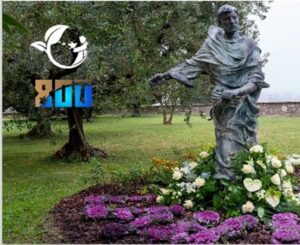 “The Canticle of Creatures is a song of praise & Reconciliation.” “It summarizes Francis’ view of God and the world; creatures and human beings; himself and the Most High God.” In the “Conclusion” of this letter the Ministers General provide us with numerous “Admonitions” or “Challenges”; refer to the following list. “The Canticle of Creatures is a song of praise & Reconciliation.” “It summarizes Francis’ view of God and the world; creatures and human beings; himself and the Most High God.” In the “Conclusion” of this letter the Ministers General provide us with numerous “Admonitions” or “Challenges”; refer to the following list.
Admonitions or Challenges
- Joyfully celebrate this 8th centenary of the Canticle
- Make the Poverello’s clear and prophetic gaze your own
- Recognize God’s imprint in every creature
- Live the call to universal fraternity by embracing all of creation – animate and inanimate
- Rediscover the beauty of being pilgrims & strangers
- Become custodians, not masters, of creation
- Become brothers and sisters of every living thing
- Become artisans of Peace and Forgiveness
- Live vulnerability as openness to others
- Integrate death into the great mystery of life
- Welcome every reality – from the brightest to the darkest within an experience of praise and restitution
- Live and promote: no lives are meaningless; no creatures are voiceless; no situations are outside of Divine Compassion
- Everything is embraced by our Father’s tenderness; everything/everyone is an occasion for praise
- See beyond appearances; grasp the dignity and beauty of all
- Become like Francis:
- Become Singers of Reconciliation and Hope
- Become Re-kindlers of Child-like Wonder
- Become Givers of Thanksgiving
- Become Caregivers of our Common Home
Please read the whole Song of Reconciliation. Go back and meditate/ponder each part individually. Let the message be totally absorbed into your being – who you become as you continue your spiritual journey – your pilgrimage to eternal happiness with the Trinity.
Posted By Teresa Redder, on September 9th, 2025 JOYFUL GOSPEL LIVING
“We adore You, O Christ, and we bless You…”
Typically, the Gospel acclamation is a verse from Scripture, proclaimed in song by the cantor. This weekend, the Church celebrates the Feast of the Exaltation of the Cross. Although the feast’s Gospel acclamation is not a verse from Scripture, it is very familiar to Catholics in our Stations of the Cross.
This little prayer is an enduring legacy of St. Francis of Assisi, whose three loves of Christ were the Crib in Bethlehem; the Cross; and Communion. As penitents, St. Francis taught his followers to say this prayer whenever they entered any church:

“We adore You, O Lord Jesus Christ,
here and in all the churches of the world,
and we bless You,
because by Your holy Cross,
You have redeemed the world.”
For many people, the Hallow application for portable electronic devices has become a powerful daily prayer tool, with so many ways to connect with God in podcasts, Scripture reflections, study guides, trivia games, meditative music, and many other spiritual delights. This year, Hallow offered the 40-day St. Michael’s Lent, a period of prayer and fasting that began on the solemnity of the Assumption of the Blessed Virgin Mary and will conclude on the feast of St. Michael the Archangel on September 29th. It was during a retreat like this on Mount La Verna in Tuscany in 1224 that St. Francis received the stigmata on this weekend’s feast day.
Because of his great love of prayer in solitude, St. Francis patterned his life by the example of the self-emptying (kenosis) Christ on the Cross. Besides his active evangelical ministry, he deliberately withdrew throughout the year to pray and fast with Christ.
During our Franciscan study pilgrimage in 2019, my husband Jeff and I visited Lago (Lake) Trasimeno, the largest lake in Italy, where St. Francis spent the Lent of 1211 in solitude on Isola Maggiore, praying and fasting from Ash Wednesday until Holy Thursday. The Little Flowers of Saint Francis (7) records that the man who rowed him to the island and back was amazed that St. Francis took with him only two loaves of bread; he returned with one and a half loaves!
In our Pilgrim’s Companion to Franciscan Places, there was a challenging spiritual reflection:
“Lago Trasimeno reminds us of one of the main tenets of Francis’ spirituality: the call to a life of penance. Penance for Francis meant total conversion to God. His experience on the island concretizes this focus for us. Here we can also challenge ourselves to the mystery of fasting:
- What fills us up?
- What fills our hearts?
- What kind of fasting is necessary in our lives so that God becomes greater and idols become less?
- How is our spiritual life bound up with the liturgical year?”
On September 1st, the Church commenced the celebration of the ecumenical Season of Creation (SOC), which will conclude on the feast of St. Francis (October 4th). The theme for this year is “Peace with Creation.” It coincides with the Franciscan family’s observance of the 800th anniversary of the Canticle of the Creatures, a hymn of praise written in the Umbrian dialect by St. Francis just before his death. What are we doing to give praise to our Creator? How does our lifestyle bring about a more just society that respects all of God’s Creation?
In his message for the 10th World Day of Prayer for Creation (September 1st), Pope Leo XIV wrote:
“Now is the time to follow words with deeds. ‘Living our vocation to be protectors of God’s handiwork is essential to a life of virtue; it is not an optional or a secondary aspect of our Christian experience’ (Laudato Si’, 217). By working with love and perseverance, we can sow many seeds of justice and thus contribute to the growth of peace and the renewal of hope. It may well take years for this plant to bear its first fruits, years that, for their part, involve an entire ecosystem made up of continuity, fidelity, cooperation and love, especially if that love mirrors the Lord’s own self-sacrificing Love.”
Next Sunday (9/21), the United Nations observes the International Day of Peace: Act Now for a Peaceful World. How appropriate that this celebration occurs during the SOC! As Christians celebrate the 1500th anniversary of the Nicene Creed, the SOC Celebration Guide 2025 noted:
“In our troubled, unequal, and divided world, we are strengthened by the confession of faith and by the ecumenical communion established in Nicaea to follow Isaiah’s call and stand firm in our witness for God’s promise of peace for all Creation. Therefore, in the face of conflicts and strife, let us proclaim God’s promise: ‘The effect of righteousness will be peace, and the result of righteousness, quietness and trust forever.’ (Isaiah 32:17)”
Christ invited all of us to take up our crosses and follow Him. That invitation does not have an assurance that it will be easy. Rather, Jesus told His followers in the Beatitudes that they would be blessed when they were persecuted or insulted by wicked people.
The Gospel reminds us that “God so loved the world that He gave His only Son.” This treasured Scripture quote inspires gratitude for a love revealed on the Cross by our Savior. Our adoration for Christ then has certitude as we knowingly and deliberately follow Him:
“…because by Your Cross, You have redeemed the world.”
Teresa S. Redder, OFS
Saint Katharine Drexel Regional Minister
Posted By Teresa Redder, on March 16th, 2025 SECOND SUNDAY OF LENT
“My brothers and sisters…stand firm in the Lord.”
 Whenever my husband Jeff and I have been on pilgrimages to other countries, we have had the privilege to meet many priests and religious who serve in the foreign missions. When Jesus shared the Good News with His first followers, He expected them to go out to all the world and share what they had seen and heard. In their limited understanding of the world at that time, though, those first disciples were limited by geographical borders that were known mainly by trade routes or conquests. So much of the world was still waiting to be explored! Whenever my husband Jeff and I have been on pilgrimages to other countries, we have had the privilege to meet many priests and religious who serve in the foreign missions. When Jesus shared the Good News with His first followers, He expected them to go out to all the world and share what they had seen and heard. In their limited understanding of the world at that time, though, those first disciples were limited by geographical borders that were known mainly by trade routes or conquests. So much of the world was still waiting to be explored!
Why was St. Paul compelled to tell the Philippians to “stand firm in the Lord”? Even in their time, people living ordinary lives in common society had to be reminded that people of faith, whose minds were occupied with earthly things, are citizens of heaven. During our Lenten journey, is our daily prayer helping us to stand firm in the Lord?
During our pilgrimages, the missionaries that we met shared many stories of their compassionate encounters with people in developing countries: education, health care, maternity services, cooperative projects for sustainability, and trauma relief for those who had seen great violence and destruction. In our Lenten experiences, most of us are safe from harm, comfortable with our food, clothing, and shelter, and far away from those who are suffering. A good question to ask ourselves during Lent: How does Catholic social teaching on solidarity shape our almsgiving? Do we hear the cry of the poor when they are suffering?
Before Ash Wednesday, I was on a special Zoom call hosted by the Franciscan Sisters of Philadelphia in Aston, PA. Their guest speaker was a staff member of Catholic Relief Services (CRS), who spoke about the need to continue funding programs that provide care all over the world. After the speaker’s opening remarks, we shared questions and comments. One of the elderly religious sisters (who participated on that call from Africa after midnight!) was a 30-year missionary to Kenya, where she had been working faithfully in AIDS ministry to children. Because of CRS support, she told us with gratitude that they no longer had any children who passed away due to AIDS. She was concerned about what would happen there when their current supplies of medicine are expended and there is no additional funding to obtain medicines.
Motivated by this Zoom call, the Franciscan Sisters’ Care for Creation Committee voted unanimously to focus the community’s Lenten almsgiving on the CRS Rice Bowl project. I visited the CRS website to see what kind of new insights were there for donors to appreciate the challenges better. The CRS Mission Statement resonates with the Gospel’s message of transfiguration:
“Catholic Relief Services carries out the commitment of the Bishops of the United States to assist the poor and vulnerable overseas. We are motivated by the Gospel of Jesus Christ to cherish, preserve and uphold the sacredness and dignity of all human life, foster charity and justice, and embody Catholic social and moral teaching.”
On the CRS home page, I found a special link that was posted on March 5th:
CRS’ Rice Bowl Program Celebrates 50 Years of Global Hunger Reduction | CRS
I can still remember the joy that our family had when our four adult children were growing up to fill the CRS Rice Bowl together during our Lenten journey.
As I thought about the Franciscan sisters, who take a vow of poverty, live in service to others, and made this a special Lenten priority because the need in the world is greater now than ever, I thought about God promising Abram that his descendants would be more numerous than the stars in the heavens. So many centuries later, his descendants (Jewish, Christian, and Muslim) number in the billions and live on five continents! Yet CRS reminds us that we must urgently take care of many of these brothers and sisters who need our compassion and generosity:
“According to the United Nations Food and Agriculture Organization, more than 580 million people could be chronically undernourished in 2030 – just five years away – if the trajectory is left unchecked. Elevated hunger levels are quickly becoming the new normal, causing long-term and generational harm to children, families and communities. More than 340 million people around the world are currently facing some level of food insecurity, with nearly 2 million facing catastrophic hunger – primarily in Gaza and Sudan. Many of these food crises involve overlapping issues that increase year after year.”
We can inspire our children and grandchildren to stand firm in our world that is too often preoccupied by earthly distractions by taking less than two minutes to watch this YouTube video about the CRS Rice Bowl’s history:
https://youtu.be/5QoPVNxKEGE
It is so easy to stand firm in solidarity with the poor:
Online: crsricebowl.org/give
Phone: 877-435-7277 (8 AM-11 PM ET) for CRS Rice Bowl
Mail (Please write “CRS Rice Bowl” on memo line of check):
Catholic Relief Services (Attn: CRS Rice Bowl)
P.O. Box 5200
Harlan, IA 51593-0700

May this CRS Prayer shape our Lenten desires:
“Jesus, Bread of Life, as we encounter You in the Eucharist this Lent, nourish us with Your love, unite us in communion with our sisters and brothers, showing us how we are connected. Transform [transfigure] our hearts, that we may be moved to share bread for life with our global family and work for a world where all can thrive. AMEN.”
Teresa S. Redder, OFS
Saint Katharine Drexel Regional Minister
|
|

 Comments are closed
