|
|
Posted By Kate Kleinert, on July 1st, 2018 July 2018
All-powerful, most holy, Almighty and supreme God,
Holy and just Father, Lord King of heaven and earth,
we thank You for Yourself, for through Your holy will
and through Your only Son with the holy Spirit,
You have created everything spiritual and corporal
… making us in Your own image and likeness,…
We thank You…
Following are excerpts taken from various sources
1
Servants of the Lord should not be ignorant of the lives and teachings of saints through which they can come to God. (Prologue) – When you come to Christ, Christianity demands the personal, intimate bond. We have to be one with him, and reflect the person, mind, will, heart and humanity of Christ.
2
On the 16th of April, after 1207 years completed since the Incarnation of the Lord … God saw that His people … had forgotten His commandments … desiring not the death of the sinner, but that he be converted and live… God willed to send workers into His vineyard. (chpt.1) – Faith is not the will to believe; it is the acceptance of truth based on the authority of God’ revelation.
3
Preoccupied with thoughts of wealth … Francis sent (a beggar away) without giving him alms … touched by divine grace, he began to accuse himself. (chpt.1) –Reconciliation is inseparable from the death of Christ. We never have reconciliation without the passion, death, and resurrection of our Lord. » Click to continue reading “Reflections from Father Francis Sariego, OFM Cap. July 2018” »
Posted By Kate Kleinert, on July 1st, 2018 St. Katherine Drexel Regional Fraternity
Regional Spiritual Assistant
St. Francis of Assisi Friary
1901 Prior Road
Wilmington, Delaware 19809
tel: (302) 798-1454 fax: (302) 798-3360 email: pppgusa@gmail.com
July 2018
Dear Sisters and Brothers in St. Francis,
The Lord give you his peace!
St. Francis of Assisi has a powerful hold over the hearts of many Catholics, non-Catholics, and even non-Christians. The ‘Poverello’ of Assisi, whose death occurred over eight centuries ago, lives on in his spiritual children and all those who have come to understand the importance of his all-embracing ministry. God offers us extraordinary signs to remind us that God is with us. The miracles that suspend or enhance the laws of nature are only messages reminding us that what seems permanent is only passing. The famous ‘bookmark’ of Saint Teresa of Avila states: Let nothing disturb you. Let nothing frighten you. All things are passing. God alone remains. Who possesses God possesses all things.
Holiness is being possessed by God. If we seek only the extraordinary, we may fail to recognize the wonderful gifts found in the ‘ordinary’ experiences of life. God is always at work fulfilling His will in both the ordinary and the extraordinary. Focusing on ‘the wonder of the miraculous’ in the life of any holy person, we may lose sight of the ever-present gifts of grace in him/her, that we too share with the saint according to our cooperation with God’s grace. » Click to continue reading “Greetings from Father Francis Sariego, OFM Cap. July 2018” »
Posted By Kate Kleinert, on July 1st, 2018 Thoughts from your Regional Formation Director
July 2018
Greetings to you my sisters and brothers in Christ and Saint Francis of Assisi.
All peace and good be with you! Well summer is here! It is only 8:00 AM here in Summit Hill and it is 80 degrees already! Hot and humid, but watch, come December we will be saying it is too cold!
I would like to take a short break from Initial Formation for July. Those who know me will know how important I think Initial formation is! It is the bedrock on which our order is built and stands firm. But ongoing formation is also important and needs our attention. Just like initial formation, ongoing formation should be for seculars by seculars. What do I mean by that? Great question.
What that means is that that since regionalization in the 70’s we are intended to be an order true to ourselves and governed by ourselves. Therefore formation of all types should primarily be led by the seculars at a local fraternity level, a regional fraternity level and so on. Does that mean there is no place for our beloved First, Second and Third Order Regular Brothers and Sisters in formation? Absolutely not! They just should not take the lead nor should they be giving formation on a regular basis. That is the job of the Council and Formation Director at all levels.
This might seem like a daunting task, but just like with Initial Formation, there are incredible tools out there. You are not alone! What I have found is that an occasional journey back to basics “The Franciscan Journey” is always a good thing. Take one of the chapters and break it down to 15 – 20 minute small group discussions and then summarize at the larger fraternity level. This is good for several reasons; first, there is always room for refresher and renewed commitment to our rule. Secondly, there are sisters and brothers out there that for one reason or another didn’t necessarily get the best initial formation. This process helps them grow.
Besides the Franciscan Journey, there is a lot of material right on our Regional web site1 under formation resources. Just remember, we should keep it Franciscan. What I mean by that is there are a lot of good and noble Catholic things out there, but we are distinctly Franciscan. We should focus on Franciscan Spirituality. Another good guideline, use only material approved by the Church.
Next month we will continue the discussion on Inquiry and tips on progressing thru the process.
Pax et Bonum
Peace and all Good
Ted Bienkowski, OFS
SKD Region Formation Director
1 http://www.skdregion.org/ under formation resources
Posted By Kate Kleinert, on June 2nd, 2018 Greetings to you my sisters and brothers in Christ and Saint Francis of Assisi.
All peace and good be with you! It appears that spring has actually arrived and we are now heading towards summer! It is time to pick up where we left off in April, our discussion about Initial Formation and in particular, Inquiry. » Click to continue reading “Thoughts from Your Regional Formation Director – June 2018” »
Posted By Kate Kleinert, on June 1st, 2018 June 2018
All-powerful, most holy, Almighty and supreme God,
Holy and just Father, Lord King of heaven and earth
we thank You for Yourself, for through Your holy will
and through Your only Son with the holy Spirit
You have created everything spiritual and corporal
… making us in Your own image and likeness …
We thank You …
Following are excerpts taken from various Franciscan and other sources.
1
The truly clean of heart are those who look down upon earthly things, seek those of heaven, and, with a clean heart and spirit, never cease adoring and seeing the Lord God living and true (Admonitions,#16) – Let yourselves be charmed by Christ…attracted by his example…loved by the love of the Holy Spirit…fall in love with Jesus Christ.
2
We carry Him (Jesus) in our heart and body through love and a pure and sincere conscience; and give Him birth through a holy activity, which must shine before others by example. (Letter to Faithful) – Do not be afraid! Open wide the doors to Christ!…Open to his saving power.
3
He taught them to mortify not only vices and to check the promptings of the flesh, but also to check the external senses, through which death enters the soul. (1Celano,chpt.16) – Human beings are called to become disciples of that Other One who infinitely transcends them, in order to enter at last into true life.
4
Unbending in discipline he stood upon his guard, taking the greatest care to preserve purity of both soul and body (Major Legend,chpt.5) – In the mystery of his cross and resurrection, Christ…has bridged the infinite distance that separates all people from new life in him.
5
He used to say that it should be incomparably more tolerable for a spiritual man to endure great cold in his flesh rather than to feel even slightly the heat of carnal lust in his heart. (Major Legend,chpt.5) — Faith must be quickened by love. It must come alive through the good works which reveal God’s truth in us.
6
If, at the instigation of the devil, any brother commits fornication, let him be deprived of the habit he has lost by his wickedness, put it aside completely, and be altogether expelled from our Order. Afterwards he may do penance. (Earlier Rule,chpt.13) – Being a Christian must mean being a witness for Christ.
7
The Rule of the Lesser Brothers is this: to observe the holy Gospel of Pour Lord Jesus Christ by living in obedience, without anything of one’s own, and in chastity. (Later Rule,chpt.1) – The commandments must … be understood … as a path involving a moral and spiritual journey toward perfection, at the heart of which is love.
8
He was naturally courteous in manner and speech, and following his heart’s intent, never uttered a rude or offensive word to anyone … His reputation, because of this, became so widespread…that many who knew him said that, in the future, he would be something great. ( Three Companions,chpt.1) – Through the Spirit, (Jesus) gives the grace to share his own life and love and provides the strength to bear witness to that love in personal choices and actions.
9
He taught not only that the vices of the flesh must be mortified and its prompting checked, but also that the exterior senses, through which death enters the soul, should be guarded with the greatest care. (Major Legend,chpt.5) – God who is always merciful even when he punishes … preferred the correction rather than the death of a sinner, did not desire that a homicide (murder of Abel by Cain) be punished by the exaction of another act of homicide.
10
To carry in his own body the armor of the cross, he held in check his sensual appetites with such a rigid discipline that he scarcely too what was necessary for the sustenance of nature. (Major Legend,chpt.5) – Peace … must become the goal of all men and women of good will.
11
At that time the brothers dedicated themselves to the practices of fasts, of vigils, of work, in order to dominate the incentives of the flesh. (Anonymous of Perugia) – Peace is our duty: our grave duty, our supreme responsibility.
12
The brothers were sometimes surprised that he did not often visit such holy handmaids (St.Clare and Sisters) of Christ…but he would say: ’Don’t imagine, dear brothers, that I don’t love them fully…But I am giving you an example, that as I do, so should you also do’. (2Celano,chpt.155) – t the last judgment we shall all be judged without distinction on our practical love of our brothers and sisters.
13
When he spoke with her (St. Clare) or about her, he never mentioned her by name, but he called her the Christian. (Bro. Stephen) – It will be in the practical love they have shown that many will discover that they have in fact met Christ, although without having known him before in an explicit way.
14
Father Francis exhorted her (St. Clare) to despise the world…and instilled in her ears the sweetness of being wed to Christ, persuading her to preserve the precious gem of her virginal chastity for her blessed Spouse. (Legend of St. Clare,chpt.5) – If you want peace, reach out to the poor!
15
(St. Clare) entrusted herself totally to Francis, choosing him as her guide, after God…and she accepted with an ardent heart all that he taught her about the good Jesus. (Legend of St. Clare,chpt.6) – (The church is a ‘pilgrim church’); her pilgrimage is interior: it is a question of a pilgrimage in the Holy Spirit … strengthened by the power of God’s grace promised her by the Lord …
16
The week that Francis passed from the this life, Clare … informed Francis of her desire to see him. The saint, informed of this, was deeply moved, because he loved Clare and her sisters with a father’s love. (Legend of Perugia) -(There is) a need for a profound transformation of hearts through the rediscovery of the father’s mercy and through victory over misunderstanding and over hostility among brothers and sisters.
17
(As the body of Francis is brought to Assisi passing San Damiano, Clare and sisters weep saying):Father, what shall we do…Why are you abandoning us poor women?… all consolation ebbs away along with you …who will comfort us in so great a poverty, poverty of merit as much as of goods? Who will help us in temptations? (1Celano,bk.2,chpt.10) – Refusal of God’s fatherly love and of his loving gifts is always at the root of humanity’s divisions.
18
(Clare and Sisters continue): You, who experienced so many temptations! Who will comfort us in the midst of distress? You, who were so often our help in times of distress! What bitter separation!, what painful absence! (1Celano,bk.2,chpt.10) – God, ‘rich in mercy’, … does not close his heart to any of his children.
19
Among the virtues Francis loved and desired the brothers preserve after holy humility he loved the beautiful and immaculate virtue of chastity.(Mirror, 86) – (God) waits for (his children), looks for them, goes to meet them at the place where the refusal of communion imprisons them in isolation and division.
20
Unbending in discipline, he kept an exceedingly attentive watch over himself. He took particular care in guarding the priceless treasure in a vessel of clay, that is, chastity, which he strove to possess in holiness and honor through the virtuous purity of both body and soul. (Minor Legend,chpt.3) – The initiative on God’s part is made concrete and manifest in the redemptive act of Christ, which radiates through the world by means of the ministry of the church.
21
His mastery over the flesh was now so complete that he seemed to have made a covenant with his eyes; he would not only flee far away from carnal sights, but also totally avoid even the curious glance at anything vain. (Minor Legend,chpt.3) – The essence and role of the family are in the final analysis specified by love.
22
Even though he had attained purity of heart and body, and in some manner was approaching the height of sanctification, he did not cease to cleanse the eyes of his soul with a continuous flood of tears. (Minor Legend,chpt.3) – The family has the mission to guard, reveal and communicate love, and this is a living reflection of and real sharing in God’s love for humanity and the love of Christ the Lord for the church his bride.
23
We prohibit anyone of you to wander outside of obedience with the habit of your holy religion and thus corrupt the purity of your poverty. (‘Cum Secundum’ of Pope Honorius III) – Man cannot live without love … His life is senseless if love is not revealed to him – if he does not experience it and make it his own, if he does not participate intimately in it.
24
Encompassed by the weakness of the flesh, a human cannot follow the spotless crucified Lamb so perfectly as to avoid contacting any filth. Therefore he taught those who strive after the perfect life to cleanse themselves daily…(Major Legend,chpt.5) -(We are) to become a temple of the Blessed Trinity. What greater degree of communion with God could (we) ever aspire to?
25
Although he had already attained extraordinary purity of heart and body, he did not cease to cleanse the eyes of his soul with a continuous flood of tears, unconcerned about the loss of his bodily sight. (Major Legend,chpt.5) – The hectic pace of daily activity, combined with the noisy and often frivolous invasiveness of the means of communication, is certainly not something conducive to the interior recollection required for prayer.
26
(The Dominican theologian after visiting with Francis said to the friars) My brothers, the theology of this man, held aloft by purity and contemplation, is a soaring eagle, while our learning crawls on its belly on the ground. (2Celano,bk.2,chpt.69) – You have made us for yourself, O Lord, and our hearts are restless until they rest in you. (St. Augustine)
27
I beg in the Lord all my brothers who are priests, or who will be, or who wish to be priests of the Most High that whenever they wish to celebrate Mass, being pure, they offer the true Sacrifice of the most holy Body and Blood of our Lord Jesus Christ with purity and reverence, with a holy and unblemished intention…(Letter to the Order) – The Holy Spirit is the gift that comes into man’s heart together with prayer. In prayer he manifests himself first of all as the gift that ‘helps us in our weakness’.
28
Seeing the Foe was carrying the day, the most high Lord sent in the cavalry with a well-trained commander. St. Francis was chosen as standard-bearer…He wanted no one to ride with him who did not accept the reins of three bridles: poverty, obedience, and chastity. (Jacopone of Todi) – Evangelization will show its authenticity and unleash all its missionary force when it is carried out through the gift not only of the word proclaimed but also of the word lived. In particular the life of holiness …
29
Wherever they may be or may go, let all the brothers avoid evil glances and association with women…Let us all keep close watch over ourselves and keep all our members clean…(Earlier Rule,chpt.12) – The life of holiness … constitutes the simplest and most attractive way to perceive at once the beauty of truth, the liberating force of God’s love, and the value of unconditional fidelity to all the demands of the Lord’s law…
30
Saint Francis used to engage carefully in a daily, or rather, constant examination of himself and his followers. Allowing nothing dangerous to remain in them, he drove from their hearts any negligence…he was on his guard at every hour…He taught them to mortify not only vices and to check the promptings of the flesh, but also to check external senses, through which death enters the soul. (1Celano,chpt.16) – The Mother of God is a type of the church in the matter of faith, charity and perfect union with Christ … the church brings forth to a new and immortal life children who are conceived of the Holy Spirit and born of God. (Vatican II)
Posted By Kate Kleinert, on June 1st, 2018 St. Katherine Drexel Regional Fraternity
Regional Spiritual Assistant
St. Francis of Assisi Friary
1901 Prior Road
Wilmington, Delaware 19809
tel: (302) 798-1454 fax: (302) 798-3360 website: skdsfo email: pppgusa@gmail.com
June 2018
Dear Sisters and Brothers in St. Francis,
The Lord give you his peace!
ur Seraphic Father Saint Francis of Assisi was a totally Eucharistic soul whose love for the Eucharist led him to revere all priests, even those whose lives were not as exemplary as they should have been. Why? Because they give us spirit and life through the sacraments they offer and the Word they proclaim. All the faithful have a share in this marvelous gift of the priesthood through their baptism and attentive participation in the celebration of the Eucharist.
The immediacy with which the celebration of the Eucharist ends seems so abrupt. After the faithful have received the Eucharist and shared in their Holy Communion the liturgy seems to say a quick ‘good-bye’, ‘be on your way’ to the assembled faithful. Nothing of the sort! The Dismissal is a capsulized and intensely packed moment that carries with it an extraordinary privilege, responsibility, and awesome power.
When (Jesus) had risen, early on the first day of the week, he appeared first to Mary Magdalene…Then He appeared to the (disciples) … He said to them, ‘Go into the whole world and proclaim the Gospel to every creature. Whoever believes and is baptized will be saved; whoever does not be believe will be condemned. These signs will accompany those who believe: in my name they will drive out demons, they will speak new languages. They will pick up serpents with their hands, and if they drink any deadly thing, it will not harm them. They will lay hands on the sick, and they will recover… (Mark 16: 9-19) And behold I am with you always, until the end of the age. (Matthew 28: 20) (The disciples) went forth and preached everywhere, while the Lord worked with them and confirmed the word through accompanying signs. (Mark 16: 20)
The moment we sign ourselves with the sign of our salvation in the name of the Father, Son, and Holy Spirit, we begin an extraordinary spiritual journey. This mystical experience of our salvation history is an intimate immersion and participation in the Passion-Death-Resurrection-Glorification of Jesus. As the early followers of Jesus, we also listen to and reflect on the words of our ancestors in faith. As the first disciples, we listen to and learn from the words of Jesus. In the gift of the Holy Spirit Who will remind you of all that I said, we grow in the strength that will empower us to go forth and be ‘heralds of the Great King’.
Our Seraphic Father proclaimed himself as the ‘Herald of the Great King’ when confronted by a band of robbers. The robbers beat, stripped, and threw St. Francis into a ditch, considering him a mentally challenged person of little worth. They could not and would not accept or understand the freedom and joy that Francis had encountered when he allowed Jesus to ‘take over’ his life. The Eucharist, celebrated well and received with the appropriate spiritual dispositions empowers us in the same way to be free to ‘be Christ’ and proclaim Him to all the world. We become ‘heralds of the Great King’. We are entrusted not only to bear a message to others in words, but to become the message in our actions. With courage, and fearless of any opposition we might receive for the sake of the Name, we preach Jesus with our lives. How others receive the message/messenger depends on human nature that influences that reception.
Today we sense a growing aversion in many areas of our world to Christ and His message. There are those who seek to follow Him with a sincere heart. There are those who follow the image they have created in their own likeness that responds to their personal situations rather than His Word. There are those who stand in opposition to Christ, even going so far as to proclaim they are acting in His name.
Often those who seek to foster a love for the Gospel, the Church, and our Catholic Christian values and traditions face the same problems the first followers of Jesus, and all sincere seekers of Truth, face down through the centuries. If they are not physically attacked, those who seek to do God’s will and live in His Truth are beaten with barrages of negativity and harsh words, or stripped of integrity by slander, false accusations, or even by an embellishment of the truth for the sake of destroying the reputation of the innocent, who are left on the ‘road of indifference’ or in the ‘ditch of discouragement’ alone to fend for themselves with their physical, and sometimes spiritual, strength depleted. There is no stifling the power of God and His Spirit in those who seek His will. We find strength in our weaknesses, as St. Paul reminds us when speaking of his own vulnerabilities and defects. One of the great Fathers of the early Church, Tertullian, stated: The blood of martyrs is the seed of the Church. What greater ‘martyrdom’ is there than the ‘witness’ of bearing with patience, trust, and forgiveness, an ‘ongoing death’ that seeks to destroy the soul over the course of days, weeks, months and perhaps years! What greater amount of ‘blood’ can we shed than the ‘lifeblood’ of our time, talents and even treasures spent in the daily practice of our faith and its defense against the power of the one who is in the world’. This ‘one in the world’ is always at work insidiously in the minds and hearts of those who proclaim a ‘heaven on earth’ and a god created to their own image!
The Eucharist offers us a bit of heaven on earth,. We bask in the light of the Son, and find strength and peace in Him. Once we have received the Lord in the Eucharist at Mass, it seems as though everything precipitates so quickly that we have little time to spend with the Lord in the protected solace of the church, chapel or other ‘sacred space’. The brief words and quick dismissal, Go, the Mass is ended or perhaps, translating the words literally, Go, it is sent, are an urgent commission entrusted to all who participated (and the key word is ‘participated’) in the Eucharist. Christ sends us out, as He did His disciples when He ascended to the Father, to bring to others what we have seen with our own eyes, heard with our own ears, and touched – Jesus. The commission is urgent. Thus the dismissal is immediate. We have celebrated the mysteries of our salvation. We have re-presented the Passion-Death-Resurrection-Glorification of the Savior. We have actively participated in the Mass – we are witnesses to all this. There is no time to waste. We must be out and about with the Lord and proclaim Him with our lives!
At the very beginning of the Acts of the Apostles we read: (Jesus said to His disciples) you will be witnesses in Jerusalem … and to the ends of the earth … As (the disciples) were looking on, he was lifted up … from their sight. While they were looking intently at the sky … suddenly two men dressed in white garments stood beside them. They said, ‘Men of Galilee, why are you standing there looking at the sky? ( cfr. Acts 1: 1-12) The celebrant conveys the same command to us at the end of Mass. It is as though he were saying: ‘You have celebrated the sacred mysteries of our salvation. You have entered the ‘inner circle’ of the Great King’. You have been privileged to be entrusted with His message and His Spirit to inform and remind you. The Victim is sacrificed. Our offering is sent and received by the Father. The Sacred Communion that empowers those who receive worthily has been received and consumed. What are you waiting for? Don’t stand around! It’s time to go and be the One we received. Drive out the demons of ill will, confusion, doubt, discouragement, despair by the spirit of goodness and compassion. Speak the new language of Christ’s command of love that can be understood by anyone regardless of ethnic origin or even religious affiliation. Deal with the deadly serpents of verbal and physical persecution for the sake of the Name. Know that I am with you all days even to the end of the age. Don’t fear the deadly poison of a world that insidiously attempts to corrupt mind and heart from within with seductive enticements and glittering allurements. Lay hands of reassurance and sensitivity on those who have grown ill through lives that are weak, those who have possibly given up … Be their strength … Be the Jesus you have celebrated and received to them’.
Do not forfeit what divine authority confers on you. Put on the garment of holiness, gird yourself with the belt of chastity (transparency of character and life) . Let Christ be your helmet, let the cross on your forehead be your unfailing protection. Your breastplate should be the knowledge of God that he himself has given you. Keep burning continually the sweet-smelling incense of prayer. Take up the sword of the Spirit. Let your heart be an altar. Then, with full confidence in God, present your body for sacrifice. God desires not death, but faith; God thirsts not for blood, but for self- surrender; God is appeased not by slaughter but by the offering of your free will. (Saint Peter Chrysologus, Sermo 108)
Spiritual Children of St. Francis of Assisi do not use prayer, personal sacrifice, and even charitable giving as an excuse to keep aloof from the realities of life. Our Eucharist is celebrated sacramentally everyday at the altar, and then continued in the streets and our homes through our daily activities. Once we’ve received the sacramental Jesus and allowed the grace of His Spirit to flow through our veins, we must ‘Go, the (liturgical) Mass is ended’ … ‘It is (or we are) sent’, to bring others, to lead the whole world, into the mystery of God’s love in the Sacrifice and Sacrament of Jesus the Christ. The Eucharist is not just a goal to be reached but also a starting point that leads to greater heights in, with, and for God and His People. The priest who acts in persona Christi (in the person of Christ) accompanies us as one of God’s People, and prays with and for us as one set aside to intercede as a ‘mediator’ between the divine and the human. He too is called to be victim with the Victim. He and those entrusted to his ministry are called to share in the Victory of the Eucharist that fills the world with the Real Presence of an awesome God. God invites us all to an intimate relationship with Him, and then commissions us to be ‘Eucharist’, to be an act of thanksgiving in God to, with, and for all who accept His Love.
Continue to pray for all priests and those contemplating the priesthood. Pray that we priests live according to the Heart of the Savior in Whose person we live, and move, and have our being. Pray that we may be willing ‘victims’, if the Lord should ask that grace of us, that others with and through us may experience the victory promised by the One Who said: I have conquered the world. Do not be afraid. ‘Greater is the one within you that the one in the world’. ‘Behold, I am with you always, even to the end of the age’. Pray for yourselves, as I do for you, that the Jesus we celebrate and receive may always be the One Whom others see in you.
May the Eternal High Priest, Jesus, show us His Most Sacred Heart, pierced by the centurion’s lance, that we may enter the door thrown wide open leading to the Father’s loving embrace. May Mary, Queen and Mother of our Seraphic Family, keep us in the depths of Her Immaculate Heart. May Our Father St. Francis of Assisi watch over each one of us, his Spiritual Children, with loving care.
Peace and Blessings
Fr. Francis A. Sariego, O.F.M. Cap.
Regional Spiritual Assistant
Posted By Kate Kleinert, on June 1st, 2018 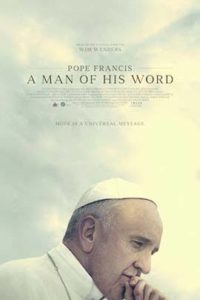
On Wednesday, I took myself to the movies and saw Pope Francis: A Man of His Word. I knew it only had one more showing at the Bryn Mawr Film Institute and yet I was dragging my feet about going. I told myself the week before that I was absolutely going to get there before it left the theater. But every day there were a half dozen reasons why it couldn’t be that day. It wasn’t going alone that bothered me. In the nine years that I have been widowed, I have learned if I want to do something….go do it!
So to insure that I got there, I went on line and bought my ticket. Now that I had spent $$, I was much more likely to get there. And so I went.
To my surprise and delight, the opening scene is about St. Francis. The movie hadn’t run more than 10 minutes when I was rummaging in my handbag for paper and pen. I wanted to write down everything the Pope was saying.
I have loved Pope Francis from the day we saw the white smoke. After seeing this movie, I love him more. He is the definition of humility……and kindness…..and compassion. But he is not afraid to tell it like it is.
The first thing I wrote down on a scrap of paper I found in my pocketbook was the Pope’s question: “Who is the poorest of the poorest of the poor?” Mother Earth! Because we rob her continually and don’t give back. Sounds like a Franciscan opportunity to me!
The next note I have is “The Church is suffering from Spiritual Dementia”. Wow. He pulls no punches there. I take the message as the Church has forgotten where it came from. Go back to the grassroots of the church and look around. Yes, there were troubles and persecutions, but the Apostles didn’t worry about where they would sleep at night or where their next meal would come from. Carrying God’s love out to the people was all they could or needed to carry.
Then my notes went to “We are a culture of waste. We look at the Earth upside down. We are not the Earth’s master but its caretaker”. Culture of waste, you can say that again. Every part of our lives has become disposable. Food, products, people…. even ourselves. How much do you value yourself? Enough to slow down? Another quote from the movie is “We run with the accelerator all the way down which ends up affecting our mental health, physical health and spiritual health.” I need to take some time to meditate on this one!
I know there were many more jewels to be had from this movie and I wasn’t keeping up with my note taking. I want to see the movie again to hear what I missed the first time and to have what I did hear be reaffirmed.
The movie ended beautifully with another scene of St. Francis. When I walked out of the theater, there was a woman standing on the sidewalk waiting for her husband to pick her up. She saw my Tau cross and asked if I had just seen the Pope Francis movie. When I said yes, we looked at each other and just sighed. We talked for several minutes and I found out her father had been a Secular Franciscan. When her husband pulled up, my new friend, Peggy, and I spontaneously hugged each other. It was a blessed moment. Two days later, I’m still feeling blessed.
The movie isn’t being shown in many of the main stream theaters, but if you Google the title, Pope Francis, A Man of His Word, all the places which are showing it will come up. Do yourself a huge favor and go see it. You are worth it!
Posted By Kate Kleinert, on May 6th, 2018 Thoughts from your Regional Formation Director
May 2018
Greetings to you my sisters and brothers in Christ and Saint Francis of Assisi.
All peace and good be with you! It finally looks like spring has arrived. NEPA, north of the tunnel, hasn’t had snow or ice for several weeks and our flowers and trees are blooming praise God.
On April 22, 2018 Holy Cross Fraternity had the privilege to profess two candidates1. It was a wonderful experience and a joy filled time for all! But it got me thinking, along with some other events, about profession and the deeper meaning. It got me thinking it is time to remember what profession means and what we all actually did during that priceless Mass.
I want to start with something I know you all are familiar with but is always worth repeating. That is Father Cangelosi words, “Indeed, most people have foggy ideas2 on the value of Profession in the Secular Franciscan Order and because of this many Secular Franciscans do not live the “grace” of Profession for what it really is. A true nuptial alliance with Jesus Christ3 aimed at a further consecration to God and at accomplishing a closer bond to the Church to reach the perfection of love and the realization of Saint Francis mission.4”
We must work hard to not let our Fraternities be “Foggy” places or not fully embrace all that profession is; “A true nuptial alliance with Jesus Chris aimed at a further consecration to God and at accomplishing a closer bond to the Church to reach the perfection of love and the realization of Saint Francis mission.” As Father Cangelosi said, we have been professed into a nuptial relationship for the furtherance of the Kingdom of God and by that relationship firmly bound to each other, the Church and all that the church is! We are not alone, nor are our fraternities. We are all bound together and journeying together.
As a reminder to what we actually say during our profession is important, all of it is important, but here I will focus on the actual “words of profession”.
“I, (Name), by the grace of God, renew my baptismal promises and consecrate myself to the service of his kingdom. Therefore, in my secular state, I promise to live all the days of my life the gospel of our Lord Jesus Christ, in the Order of Franciscan Seculars, by observing its rule of life. May the grace of the Holy Spirit, the intercession of the Blessed Virgin Mary, our holy father Saint Francis, and the fraternal bonds of community always be my help, so that I may reach the goal of perfect Christian love.5”
Those words are powerful and full of significance. What does it mean to consecrate oneself?
{Verb (used with object), consecrated, consecrating6. 1 – to make or declare sacred; set apart or dedicate to the service of a deity: to consecrate a new church building. 2 – To make (something) an object of honor or veneration; hallow: a custom consecrated by time. 3 – To devote or dedicate to some purpose: a life consecrated to ministry. 4 – To admit or ordain to a sacred office, especially to the episcopate. 5 – To change (bread and wine) into the Eucharist.}
In our case number 3 is the definition to use. We promised to dedicate ourselves to the church, the order and the rule. We made that promise to each other, to the Church thru the ecclesial witness and to those participating other than our sisters and brothers. We should never forget we are family and an ecclesial order bound to each other and our higher fraternities by our promise!
Next month we will continue the discussion on Inquiry and beyond.
Pax et Bonum
Peace and all Good
Ted Bienkowski, OFS
SKD Region Formation Director
1 Media presentation available on the HCF web site: www.holycrossfraternity.wordpress.com or on the HCF You-Tube Channel: https://youtu.be/74KqWOZfDB8
2 Emphasis mine
3 Emphasis mine
4 Emphasis mine
5 Taken directly from the “Ritual of the SFO”
6 Modified from the New Catholic Dictionary (On Line) Emphasis mine
Posted By Kate Kleinert, on May 1st, 2018 May 2018
Hail, O Lady, holy Queen, you are the virgin made church
and the one chosen by the most holy Father in heaven
whom He consecrated with His most holy beloved Son
and with the Holy Spirit the Paraclete,
in whom there was and is all the fullness of grace and every good.
Hail, His Palace! Hail, His, Tabernacle! Hail, His Home!
Hail, His Robe! Hail, His Servant! Hail, His Mother!
And hail all you holy virtues which through the grace and light of the Holy Spirit
are poured into the hearts of the faithful so that from
their faithless state you may make them faithful to God.
(Salutation of the Blessed Virgin)
1
It was not that he was a man who prayed, than he himself was a living prayer. – Abraham hoped everything would stay put, but he left everything and everyone on God’s word and traveled into the unknown.
2
His sure harbor was prayer not for a moment, … but profoundly devout, humble and prolonged as much as possible. If he began at night, with difficulty he ended his prayer in the morning. – Like Abraham, we are sustained by not simply a promise, but by the Promise of God which was fleshed out in Jesus.
3
Often, almost daily, he withdrew secretly to pray. He was inclined to do so by that same tenderness he had tasted earlier, which now visited him ever more frequently, driving him to prayer in the piazza and in other public places. – Moses longed to see his dreams completed and stopped short of the land he was allowed to see but not enter.
4
Francis … totally unaware of earthly desires through love of Christ, and strove to keep his spirit present to God by praying without ceasing lest he be without them consolation of the Beloved. – It was enough for Moses to be given evidence of the future to die fulfilled and in peace.
5
The man of God gathered with his companions … they spent their time praying incessantly, directing their efforts mentally rather than vocally to devoted prayers, because they did have liturgical books from which to chant the canonical hours. – Joseph, in spite of the rough breaks he had experienced since being sold by his brothers, refused to quit.
6
Let all the brothers always strive to exert themselves in doing good works … Servants of God, therefore, must always apply themselves to prayer or some good work. – God intends you to be the person on whom He has conferred a unique ‘personhood’. God has committed Himself to you…agree to do the same to Him.
7
Let us always make a home and a dwelling place for Him Who is the Lord God Almighty, father, Son and Holy Spirit, Who says: Be vigilant at all times and pray that you have the strength to escape the tribulations that are imminent … When you stand to pray say: Our Father in heaven. – David wanted to build a monument to God but had to prepare the material for another to build.
8
Those brothers to whom the Lord has given the grace of working may work faithfully and devotedly so that, while avoiding idleness, the enemy of the soul, they do not extinguish the Spirit of holy prayer and devotion to which all temporal things must contribute. – You who are meant to be part of God’s family, are one of the community of the Crucified One; you too must crucify self and forget ego trips…Trust Him!
9
I admonish and exhort the brothers in the name of the Lord Jesus Christ to … pay attention to what they must desire above all else: to have the Spirit of the Lord and Its holy activity, to pray always to Him with a pure heart, to have humility and patience in persecution and infirmity. – Elijah was so demoralized he wanted to give up, but God knew the inner strength of Elijah and gave him a firm ‘no’.
10
I am pleased that you teach sacred theology to the brothers providing that, as is contained in the Rule, you do not extinguish the Spirit of prayer and devotion, during study of this kind. – There is no permanent retirement for a Christian, only temporary respites from time to time to rest and reequip.
11
Francis used to say that, because of the office of prelacy or of zeal for preaching, they should not abandon holy and devout prayer, going for alms. Working at times with their hands, and performing other humble tasks like the other brothers, for good example and for the benefit of their souls, as well as others. – Jonah tried to run away from God’s Will and acceptance of his responsibilities, but he couldn’t run from God.
12
He said that (ministers of the word of God) were heralds chosen by a great king…For he used to say: The preacher must first secretly draw in by prayer what he later pours out in sacred preaching; he must first of all grow warm on the inside, or he will speak frozen words on the outside. – God still replies in the negative to those who claim a special relationship, but try to escape from responsibilities, or fall into a narrow, self-centered outlook.
13
(Description of General Minister) … He must be a committed friend of holy prayer, who can distribute some hours for his soul and others for the flock entrusted to him … – Job questioned God and demanded answers, but God gave him no answers; His questions were more profound and penetrating.
14
They never or hardly ever stopped praying and praising God…They gave thanks to God for the good done…They would have thought themselves abandoned by God if they did not experience in their ordinary prayers that they were constantly visited by the spirit of devotion. – We present-day Jobs also are promised God’s sufficiency. He gives more than answers … He shares His life with us.
15
They were so devoted to prayer that there was no hour of the night that someone could not be found at prayer in the oratory. – The God who has committed Himself to us insists on a like-minded commitment.
16
The brothers at that time begged him to teach them how to pray, because, walking in simplicity of spirit, up to that time they did not know … – The ‘covenanting’ God has given His word to us that He will not desert us. That promise has been sealed in blood – literally!
17
He implored divine clemency to show him what he had to do. – The cross has been so sentimentalized by so many generations of songwriters and preachers that it no longer has any sting.
18
He had recourse to prayer that he might insistently implore what the will of God was regarding some specific matter. – You have been given the gift of living and dying just one death. You may lay down your energies, your time, and your goods for others, or you may stockpile self until it crushes you.
19
Fasting and weeping, he earnestly prayed for the savior’s mercy, and lacking confidence in his own efforts, he cast his care upon the Lord. – Time does not necessarily heal all wounds; sometimes it merely covers them with scar tissue.
20
Foreseeing the great things that God would do through him and his Order … he was calling and praying to God that, by his mercy and omnipotence, without which human frailty can do nothing, he should supply, help, and fulfill that which he could not do by himself. – Jesus has called ‘friend’ the one we would label ‘enemy’; He pronounces themm subjects of concern rather than objects of contempt.
21
Francis said: Wait for me a bit, because I first want to pray to God that He make our journey fruitful, that Christ, by virtue of His most holy passion, be pleased to give us poor and weak men this noble prey that we’re planning to take from the world. – Peter tried to bury his guilt of denial and grief of lose in work; he couldn’t forget or conceal in activity his ‘failure’.
22
He saw St. Francis devoutly at prayer before Christ, who had appeared to him during that prayer and was in front of him … he saw Francis lifted up bodily from the earth. Because of this he was touched by God and inspired to leave the world … – The Resurrection is God’s mighty ‘no’ to depression and death.
23
He never ceased crying out to God with humble prayers and fervent affection, that God would protect the Order and grant salvation to all the friars, present and future. – A beggar pleaded for a handout and was given a hand up. God gives us His gifts that we may learn to help ourselves.
24
As blessed Francis got up, he joined his hands and, lifting his eyes to heaven, said: Lord, I give back to You the family which until now you have entrusted to me… – We carry the name ‘Christian’ and stand strong in its meaning.
25
Once while his vicar was holding a chapter, he was praying in his cell, as the go-between and mediator between his brothers and God. – Paul begged for healing and was given a thorn in the flesh, and an reminder that ‘my strength is sufficient’.
26
After I resigned my office among the brothers because of my illnesses … I am not bound at all except to pray for the religion and to show good example… the greatest help I can render to the religion is to spend time everyday in prayer to the Lord for it. – St.Teresa: Lord when you will cease to strew our path with obstacles? And the Lord: Don’t complain, this is how I treat my friends. St.Teresa: Dear Lord, that is why You have so few.
27
The abbot of the monastery of San Giustino…happened to meet Saint Francis…he humbly asked him to pray for him, and Saint Francis replied: My Lord, I will willingly pray… when the abbot had ridden away, he said to the brother with him: Wait for me a little while, brother, for I want to pay the debt I promised. – There is a certain enjoyment of unpleasant places when the challenges they offer help us to grow.
28
A pilgrim while in the body, away from the Lord, Francis, man of God, strove to keep himself present in spirit to heaven…With all his soul he thirsted for his Christ…We will tell…about the wonders of his prayer, things that we have seen with our own eyes. – The all-powerful Lord turns even the causes of our curses into good.
29
He found (Greccio) rich in poverty and there, in a remote little cell on a cliff, he could give himself freely yo heavenly things. – Jesus is not a ‘departed hero’, a ‘deceased leader’, but the living Lord, Who does not leave us to fend for ourselves.
30
Brother Body should be cared for with discernment…so it won’t get weary keeping vigil and staying fervently at prayer. – At the time when the outlook seems most bleak and pessimistic, God frequently opens new doors. Sometimes, God seemingly allows roadblocks because He has bigger plans for us.
31
When he returned from his private prayers, in which he was changed almost into a different man, he tried his best to resemble the others, lest, if he appeared glowing, the breeze of favor might cancel what he had gained. – ‘Help’ signals often are hard to pick up. God, however, patiently waits for us to be sensitive enough to detect those signs and signals from others.
Posted By Kate Kleinert, on May 1st, 2018 St. Katherine Drexel Regional Fraternity
Regional Spiritual Assistant
St. Francis of Assisi Friary
1901 Prior Road
Wilmington, Delaware 19809
tel: (302) 798-1454 fax: (302) 798-3360
website: skdsfo email: pppgusa@gmail.com
May 2018
Dear Sisters and Brothers in St. Francis,
The Risen Christ bless you with His peace!
The Middle Ages was a time of wonderful monuments built to the glory of God. Many of them were dedicated to the Great Mother of God, our Blessed Mother. The devotion of the people and the great saints of the Church saw Mary as the Virgin Mother who gave birth not only to the Christ, but as the Mother of the Christian and thus the Church as well. Saint Francis of Assisi was among these great ‘lovers of Mary’. His own Salutation of the Blessed Virgin gives proof of the depth of his awareness of Mary’s place in our Salvation History and the honor with which he personally held Her in his life. She is the virgin made church whose faith and openness to the will of the Father encourage us to abandon ourselves to so great a God and His most holy will.
Just as our Seraphic Father sought to honor Mary in his life, how could we allow this most sacred time of our Christian calendar to go by without thinking of that simple Virgin of Nazareth. Mary’s cooperation with the Father’s Will accepted the work of the Holy Spirit to ‘overshadow’ Her and thus gave us Jesus, the Messiah, our Savior and Redeemer. Infinitely less than God but eminently greater than all humanity, Mary stands above us, yet always journeys with us. We are Her children entrusted to Her by Jesus as She stood at the foot of the Cross. The ‘Woman’, praised in the first Book of Sacred Scripture, who gave birth to the Christ, is the same ‘Woman’ who gave birth to the Christian as the Church was born from the open side of Her Son as He hung on the Cross for all humankind. From that moment, Mary, the virgin made church, watches us with a mother’s eye, intercedes for us with a mother’s concern, and embraces us with a mother’s love. All humanity appeals to Mary as the ‘highest honor of our race’. Saint Francis saw Mary always in this light. Mary is Mother of the Church, because Mother of the Christ, since She is Daughter of the Father, Mother of the Son and Spouse of the Holy Spirit. Her life was an intimate relationship immersed in the reality of the Most Holy Trinity. Totally human, Mary was privileged to reach the heights of holiness ahead of time, through the merits of Her Son’s redeeming Passion-Death-Resurrection, that She might be forever a sign of the greatness and holiness to which all God’s children are called.
Mary’s presence, prominence, and popularity, even among those not of the Catholic/Orthodox expressions of Christianity, are indicative of the yearning of the human heart to be loved. After the Marriage Feast at Cana, our Heavenly Mother takes a silent place in the Gospels. We meet Her again at the foot of the Cross and then in the Upper Room awaiting the Promised Gift of the Holy Spirit on the Early Church. Not until St. John writes of the ‘Woman about to give birth’ assailed by the ‘dragon’ in the Book of Revelation do we meet ‘the Woman’ again in Scripture, and for the last time. The Church has always seen the image of the ‘Woman’ of Sacred Scripture as the image of Mary. Our love and devotion for Mary has kept Her always alive in our hearts. She is the one to whom so many of us run with our joys and sorrows, successes and failures, hopes and fears. She is the one most Catholics will defend when Her name and honor are being attacked. We speak of Her as we do of Her Son. The Real Presence of Jesus in the Sacrament is equaled by no one and nothing in this world, yet often we speak of Mary as another ‘real presence’ that accompanies us in such a way that with Her in our hearts and minds we move forward confidently. Saint Francis praised Her as Palace, Tabernacle, Home, Mother, in his Salutation of the Blessed Virgin Mary. Mary offers Jesus the space and place through which He makes Himself present among us and for us. Saint Francis is so simple, yet so profound!
What was celebrated in sign, Mary bore in Her heart and mind with a depth and reality that no one ever could or ever will be able to equal. She not only received Her Lord in the Eucharist – Her Son, Savior (yes, ‘Savior’, because She was sanctified and freed of Original Sin ahead of time in Her Immaculate Conception, but had to be redeemed nonetheless), and God – but also maintained such an intimacy with Jesus by grace upon grace, that we can lovingly and devotedly say that heaven walked with Her wherever She went. To see Mary was to see a glimpse of heaven upon earth. Isn’t that what happens to us – or at least should – when we receive Jesus in the Eucharist? When we allow the Sacred Body, Blood, Soul and Divinity of the Savior to enter our humanity and become one with us in an intimate and sacramental manner, aren’t we doing just as Our Blessed Mother did so many centuries ago? We ‘give birth in faith to Christ’ as St. Augustine reminds us. This faith and its challenges, at Communion time, must be embraced, energized, and empowered to manifest itself in the life of the one who receives the Eucharistic Lord.
In his Admonitions, our Seraphic Father writes: All those who see the sacrament sanctified by the words of the Lord upon the altar at the hands of the priest in the form of bread and wine…believe according to the Spirit and the Divinity that it is truly the Body and Blood of our Lord Jesus Christ. It is the Spirit of the Lord, therefore, That lives in Its faithful, That receives the Body and Blood of the Lord. Behold, each day He humbles Himself as when He came from His royal throne into the Virgin’s womb; each day He comes to us, appearing humbly; each day He comes down from the bosom of the Father upon the altar in the hands of the priest. As He revealed Himself to the holy apostles in true flesh, so He reveals Himself to us now in sacred bread. And in this way the Lord is always with His faithful, as He Himself says: ‘I am with you until the end of the age.
How powerful and profound is this intimate love between the human and the Divine! When we encounter individuals who are deeply in love, that love can be seen in their demeanor. Ask them about their love, though, and they seem embarrassed to respond. The intimacy true love reaches in hearts and souls ‘in love’ can only be experienced, never exhaustively explained. It can be seen in its effects but not really ‘dissected’ in explanations. Love is of God, and true love is a mystery to which all are called. Love must be lived to be experienced, and once experienced it must be loved to be lived fully. The ‘virtuous circle’ of love consists in this: the more we love, the more we know love and are capable of loving. The Eucharist we receive at the moment of Holy Communion – our ‘sacred bonding’ with Jesus – offers us the opportunity to enter the Love of God in Jesus. We allow His Holy Spirit to ‘overshadow’ our lives with grace. Just as Mary was filled with the Holy Spirit and became the Mother of God, so we have the possibility to be filled with the gifts of the Holy Spirit according to our cooperation with grace, and thus we ‘give birth to Christ in our hearts’. Even the ‘eccentricity’ of Saint Francis of Assisi can most often be attributed to his relationship with the Christ Who was so real to him in prayer and particularly in the Eucharist, that his very behavior became uninhibited. The joy of that one-ness with Christ let him forget all human respect, just as King David danced with abandon before the Arc being brought into the City of David.
The millennial continuation of the Real Presence of Our Savior among us around the world depends upon the consecration of the sacramental signs of bread and wine. This is accomplished through the ministry of those men called and ordained to the ministerial priesthood. The faithful share in this priesthood through Baptism. In the Eucharistic Sacrifice they accept to participate actively in the mystery of the Life-Passion-Death-Resurrection-Glorification of Jesus. They acknowledge their belief in the Sacrifice offered and strengthen the unity of the Mystical Body of Christ in their Holy Communion worthily received. They, like the priest, are called to let the Sacred Body, Blood, Soul, and Divinity of the Savior enter their lives and flow through every fibre of their being, thus enlivening their faith and filling their hearts with inexpressible inner joy and peace – the effects of the Eternal Love that possesses them. How many of us can really say we allow that to happen? How many of us ‘feel’ the effects of their Holy Communion, and like Saint Francis, feel a real change in attitude that even affects our demeanor? Some may even consider the expressions used above exaggerated, unreal, poetic, or of another era! We find difficulty expressing the depth of the love we experience in the Eucharist, often because we do not give ourselves the time and silence to allow the Sacred Guest to speak to our hearts, that we might ‘feel’ it. We are always in such a hurry. How many good Catholics run out of Church as soon as they have ‘devoutly’ received Communion?! The brief period after Communion, before the Last Prayer-Blessing-Dismissal, is an awesome moment, and a necessary one for us to allow the Truth Whom we have received, to lead us on the One Who is the Way, as He nourishes us with Himself and strengthens us on our journey to Eternal Life.
One of our Third Order brothers, Don Bosco, great saint of the nineteenth century, was known for his ‘dreams’. His dreams, visions, and prophecies concerning the Church are quite revealing. Among them he speaks of seeing the Church as a ship, with the Holy Father at the helm, steering it through severe weather on rough and stormy seas. The ship moves to a safe harbor as it is directed between two columns. The Eucharist is atop of one and Our Lady is atop of the other. The Eucharist and Mary are the strengths (the ‘columns’) of our Catholic Christian faith. Mary leads us to Jesus. Mother of the Most Blessed Sacrament, First ‘True’ Tabernacle, First Monstrance, She indicates the way. Let us follow Her example and invoke Her prayers and protection in the ancient Easter Marian Anthem that reminds us of the severe plague that subsided at Her intercession. The Church and the world need the intercession of the Mother of all Humanity to abate the plague of anti-Catholic, anti-Christian, anti-God campaigns that afflict the world today. May we witness Her almighty intercession with the Eternal Father, Son and Holy Spirit. We rejoice and are glad for the Lord is truly risen, and we sing our ‘Alleluia’, ahead of time, for a God Who renews the joy of our youth, as we acclaim Our Mother, the virgin made church.
Queen of heaven rejoice, Alleluia,
For the Son Whom you merited to bear, Alleluia.
Has risen as He said, Alleluia.
Pray to God for us, Alleuia.
Rejoice and be glad, O Virgin Mary, Alleuia,
For the Lord is truly risen, Alleuia.
May the Risen Lord Jesus shower you and your loved ones with peace, joy and abundant blessings for a continued Happy Easter time. May Mary, Mother of the Redeemer and our Mother, help you to live with Jesus in the light of the New Life His Resurrection offers each one of us. May our Seraphic Father St. Francis of Assisi watch over each one of you, his Spiritual Children, with loving care.
Peace and Blessings in the Risen Lord Jesus
Fr. Francis A. Sariego, O.F.M. Cap.
Regional Spiritual Assistant
|
|




 Comments are closed
